
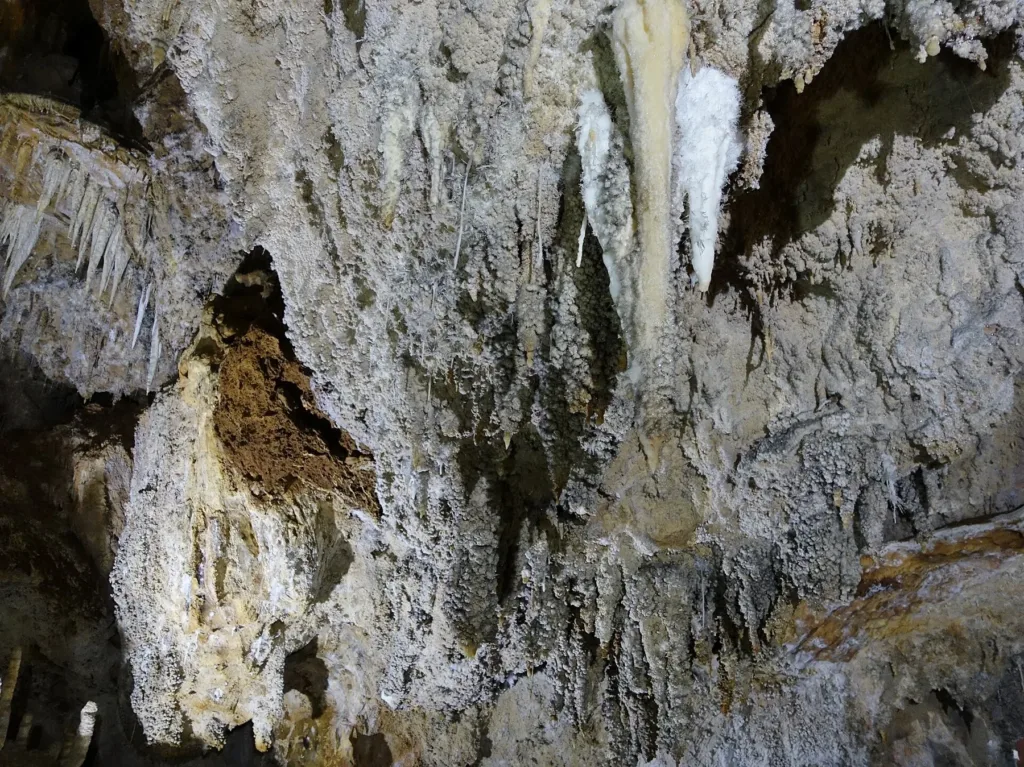

At Is Zuddas, in the municipality of Santadi, a cave is an environment that is still changing. The outer slopes of Monte Meana conceal chambers in which water has produced very different shapes: substantial masses, delicate hanging features and small networks of crystals. The most rewarding approach is not to invent a fanciful resemblance for every formation, but to notice how different scales and geometries share the same space. Attention moves from the volume of a chamber to the detail of a single wall.
The Is Zuddas Caves directory entry locates the attraction in Santadi. Its entrance lies outside the town, along the connection towards Teulada. Allow separately for the journey and the underground visit: the latter follows an organised route, while admission depends on the operator's scheduled departures. This is not a cave to explore independently by following a point on an online map. The directory provides a location, while the operator provides the arrangements for entering.
Ancient host rock and younger formations
The Monte Meana operator describes dolomitic rocks approximately 530 million years old. That age concerns the material hosting the cave; it does not mean that every stalactite is equally ancient. Separating the history of the rock from that of the empty spaces and mineral formations avoids a common misunderstanding. The mountain supplies the setting, while the decorated surfaces record other processes and timescales. They should not all be assigned to one moment simply because they can be seen together during a short visit.

According to the operator and ISPRA, the tourist route extends for roughly five hundred metres. This describes the accessible itinerary, rather than the entire underground system. Moving through successive chambers makes it possible to compare formations within their surroundings. A close photograph can reveal an extraordinary detail, but a wider view explains how the wall relates to the ceiling and the passage. Both scales matter: neither a collection of isolated mineral names nor a rapid walk captures the whole experience.
Aragonite: looking at directions and patterns
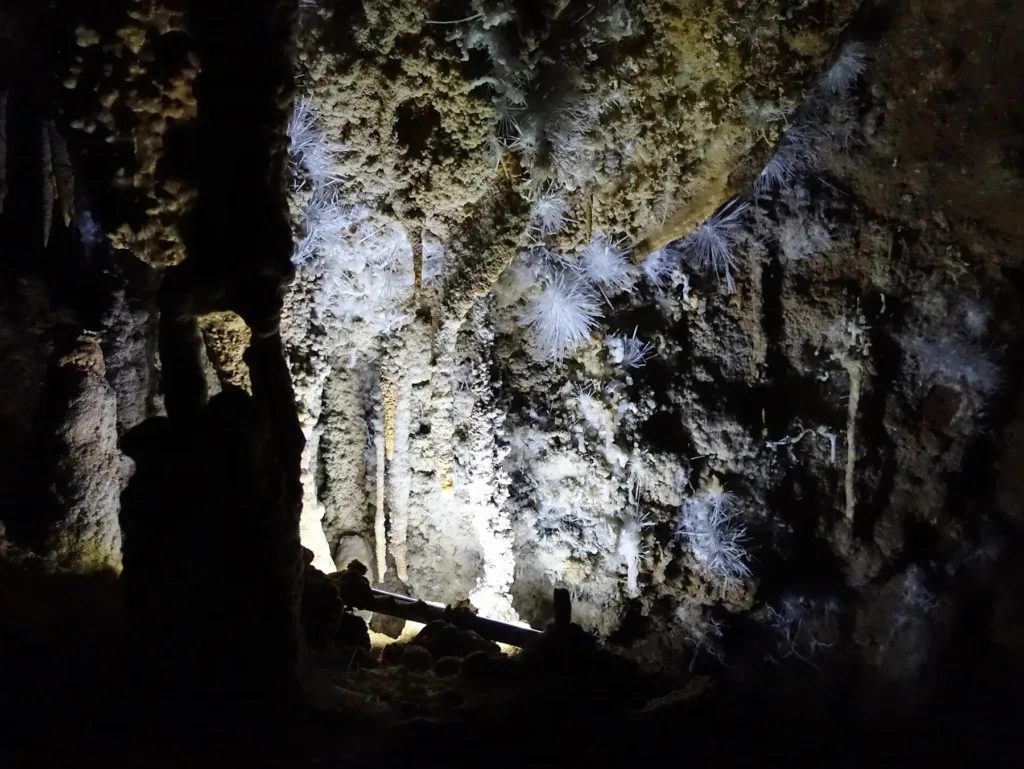
The official descriptions distinguish needle-like and eccentric aragonite among the characteristic features of Is Zuddas. One appears in groups resembling needles; the other takes irregular, thread-like forms. That gives visitors a practical visual comparison to make: a compact cluster of points has a different pattern from a branching tangle. These terms help describe what is present, although a guide should identify a particular feature when distance and lighting make different materials difficult to distinguish with confidence.
The interior photographs selected here illustrate the variety of surfaces rather than labelling every visible detail. Brighter views reveal hanging fringes, while darker compositions show the relationship between illuminated walls and unlit recesses. They do not assign a mineral identity to each patch in the image. Lighting along the route makes the forms legible, and the colours recorded by a camera also depend on that illumination. Colour in a photograph is therefore not enough, on its own, to establish the composition of a crystal.
From extraction to conservation
The cave's recent history includes a fundamental change of purpose. The operator recalls quarrying during the 1960s, specifically describing calcareous alabaster, followed by action by the Speleo Club Santadese in 1971 to close and control the cavity. Conservation is therefore part of the site's history rather than an abstract concern added to an otherwise untouched landscape. Material that had been removed came to be regarded as a heritage resource worth keeping. A surviving formation belongs within that change in attitude as well as within its geological setting.
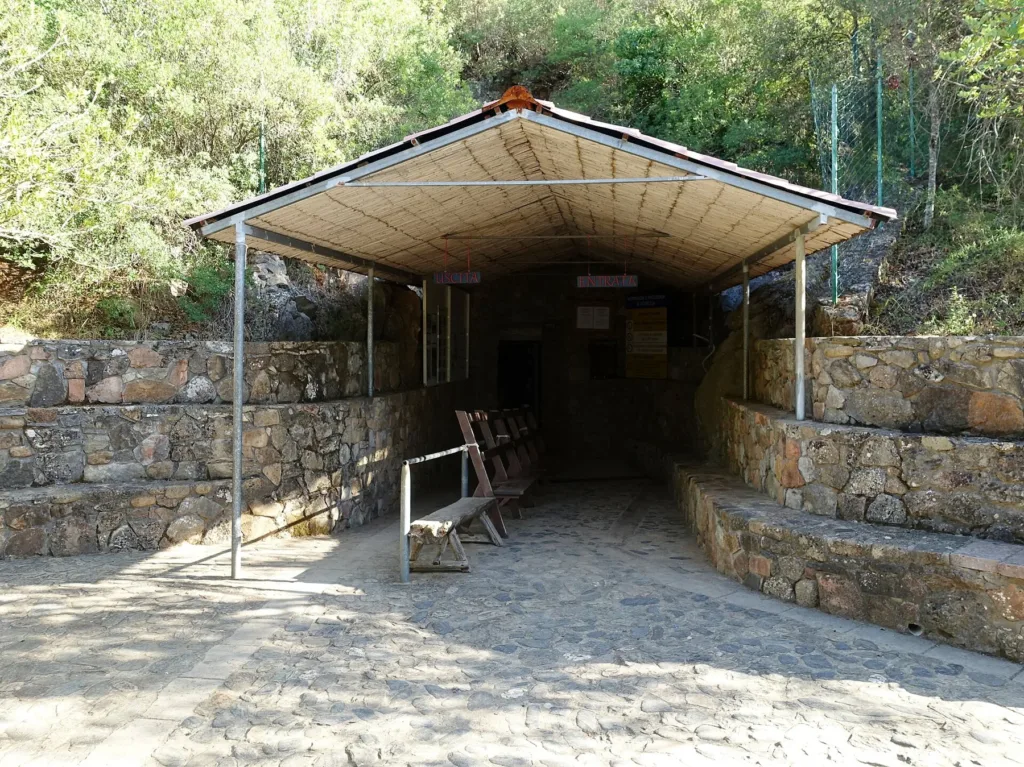
The entrance photograph dates from 2017, as do the two underground images. It shows an equipped threshold between the outside environment and the interior route, rather than documenting the present arrangement of facilities. The contrast remains informative: vegetation and daylight give way to mineral surfaces under controlled illumination. Crossing that threshold also changes the visitor's role. Following the guide and leaving formations in place helps preserve the setting that made the journey worthwhile in the first place.

Arranging a visit
The operator gives a temperature of around sixteen degrees Celsius and very high humidity. These details are useful when choosing clothing, even if the coast is hot that day. Check the official opening and booking page before travelling. It distinguishes seasonal departures and explains the relationship between online sales and tickets purchased at the entrance. Visitors with mobility requirements or other specific needs should discuss them directly with the operator instead of inferring accessibility from the route's length alone.
A lasting impression of Is Zuddas may be a relationship between features rather than a list of names: a substantial surface beside a delicate cluster, a dark recess behind an illuminated formation, or a modern entrance in front of ancient rock. Such comparisons make this particular cave more understandable. Other places in Santadi deserve their own visits and explanations. Here, the thread connecting the experience is the meeting of underground forms, the history of their use and the practical work of keeping them intact.