
Automatically translated from Italian.
As we walk in the historic center of Iglesias we cross seven centuries of history in the space of a few hundred meters. Next to the medieval Pisan walls and the Gothic portals of the Aragonese era, you just have to raise your eyes to discover another city: the Belle Époque of Iglesias.
Art Nouveau facades decorated with beaten irons, floral motifs and large windows in bovindo style still tell today the elegant face that Iglesias assumed between the late nineteenth and early twentieth century.
Belle Époque, here, was not only a historical period. It was a new way to live the city. The first gas lamps lit the streets, coffee filled with professionals and technicians from all over Europe and the arrival of electricity seemed to promise a modern and luminous future.
Iglesias in Belle Époque: cosmopolitanism, Art Nouveau style and mines
Belle Époque was an era of peace, optimism and technological progress that revolutionized Europe between the end of the nineteenth and 1914. To understand the Belle Époque of Iglesias you must start from the mines. At that time the minerals extracted in the English were urged to cities such as London, Marseille and Hamburg. The concessions were also managed by large foreign companies, which led to technical territory, engineers and administrators from different European countries.
With them came new architectural tastes and habits typical of the European urban bourgeoisie. The Art Nouveau style began to appear in the facades of the city palaces, along with elegant cafes, theatres and circles frequented by the mining ruling class.
Iglesias became a surprisingly cosmopolitan city for the time. And perhaps it is just this double soul, Sardinian and interacting together, to make it still different from many centers of the island.
Lights and shadows of the mining city
The bourgeois life followed elegant and modern rhythms. Evening walks, meetings in cafes and theatre shows animated the city center. Places such as the Electra Theatre and the Leon d'Oro Hotel were the heart of the worldly life of the Belle Époque iglesiente.
But Iglesias wasn't just this.
Not far from the historic center the world of mines began, made of massive shifts and very hard working conditions. Thousands of workers spent their days underground, exposed daily to accidents.
In 1904 these tensions resulted in the events of Buggerru, an episode linked to the first national general strike.
What to see today of the Belle Époque in Iglesias
The traces of the Belle Époque are still visible in the historic center of Iglesias. In Piazza Sella there is the bronze monument dedicated to Quintino Sella, created by the sculptor Giuseppe Sartorio at the beginning of the twentieth century.
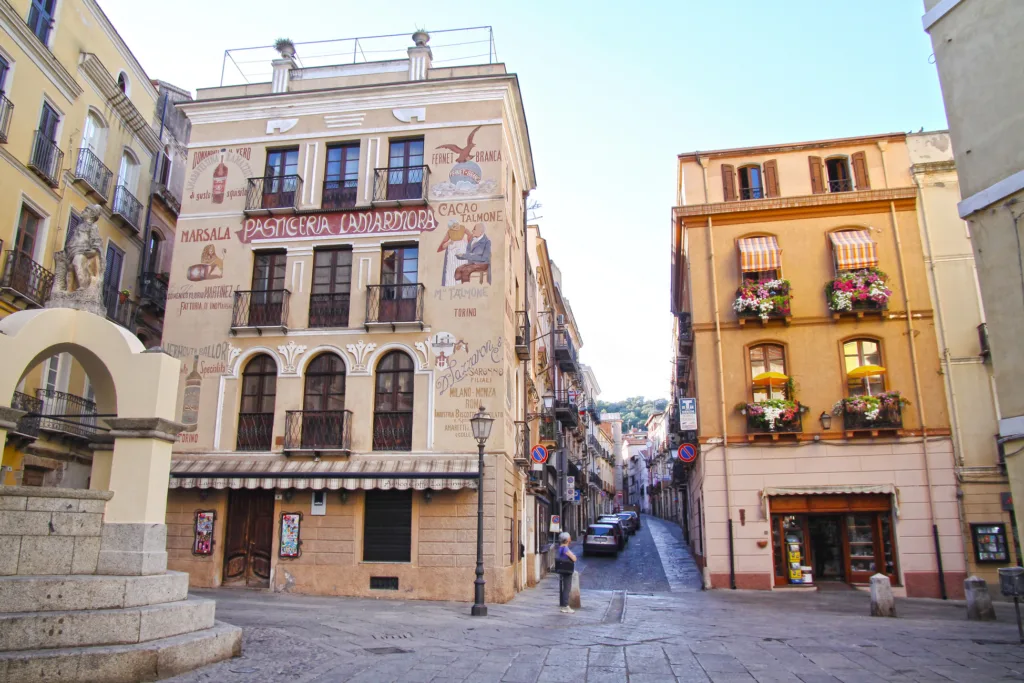
Along course Matteotti and Via Lamarmora survive some of the city's most interesting Liberty facades. Among these stands the Palazzina Lamarmora, the building of the former Offelleria Switzerland, where an advertising fresco of 1904 is still preserved, probably the oldest in Sardinia.
In via Roma, the former Istituto Tecnico Minerario Giorgio Asproni today houses the Museo dell'Arte Mineraria, with underground galleries open to the public.
Also the Monumental Cemetery of Valverde preserves the memory of those years through the white marble sculptures of Giuseppe Sartorio, dedicated to the families of the Iglesiente mining bourgeoisie.
Iglesias is worth a visit all year round, but it is in autumn and winter that the old town gives us the right light to appreciate every detail of its Liberty facades. With careful eyes that will dwell on the details the Belle Époque of Iglesias will prove not to be a closed chapter, but a story that still lives among its stones, an unconscious beauty waiting to be discovered.
Highlights: Lamarmora Square in Iglesias. Photo by Sergio Melis (Licenza CC BY-NC-SA via SardegnaTurismo).