
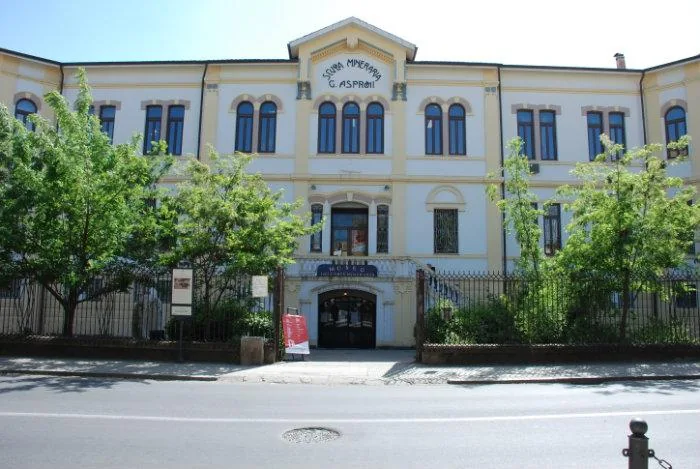

On Via Roma in Iglesias, the Giorgio Asproni Mining Institute tells an industrial story that cannot be understood by looking at an extraction shaft alone. Its subject is the education of people expected to understand, measure and organise mining work. The school façade, with the institution's name displayed centrally, gives that public function a visible form. Its educational history began before the construction of the present building.
To locate the complex, use the directory entry for the museums housed in the Mining Institute, at Via Roma 47. The geographical point identifies the premises, but a museum listing is not permission to walk through school areas. This article concerns the school's history. Museum collections and visitor routes have their own access arrangements, which need to be checked separately.
A school created for a practical need
The city tourism service records the institution's foundation in 1871 on the initiative of Quintino Sella, to train mining supervisors and workshop supervisors. It answered a demand for technical knowledge within the mining industry. Thinking of education as part of that infrastructure broadens the story beyond machinery: lessons, practical exercises and qualifications also helped the sector operate and shaped the responsibilities people could assume within it.

The institution's foundation and the construction of its building are different events. The archival inventory places the first classes in the former convent of San Francesco, while the Via Roma premises followed in 1911. Years of teaching therefore separate the two milestones. Looking at the façade means encountering one phase of an institutional history, rather than necessarily standing where that history began.
Looking at the façade
SardegnaCultura describes a symmetrical front with projecting lateral sections, a recognisable central portion and paired window openings. The institution's name occupies a prominent position near the central summit. In the photograph dated 2011, trees and the boundary fence partly overlap the lower level. The image also demonstrates how the appearance of the architecture depends on the position chosen along the street.
One useful comparison is to follow the upper outline first, then the repeated arrangement of windows. The general order becomes clear without identifying every ornamental feature. Rhythm across the front gives the building a recognisable identity, while its inscription connects the physical structure with the institution it serves. These relationships can be examined from outside without assuming that the interior is freely accessible.
Asproni and support for education
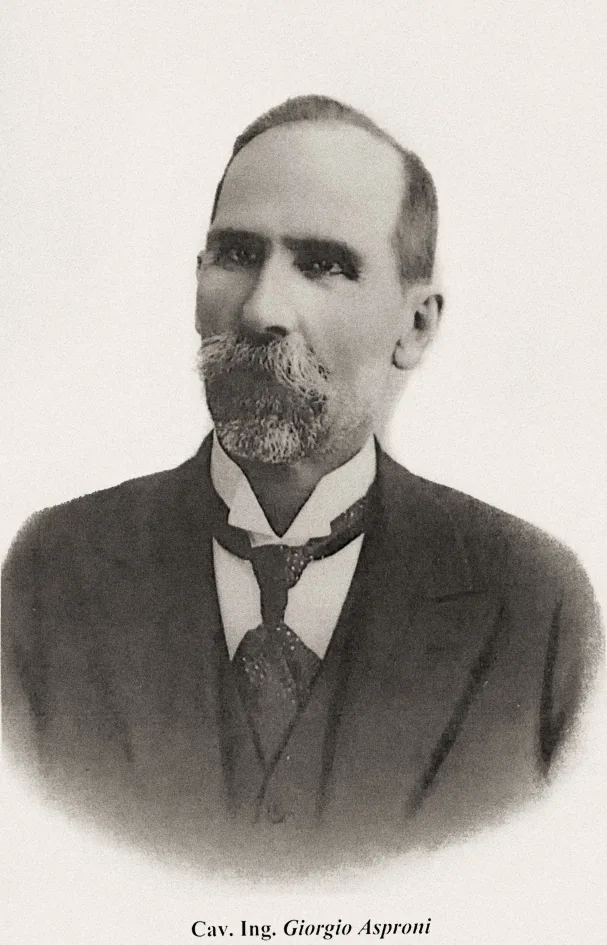
The archival inventory records Giorgio Asproni's donation in 1913 to support the school and scholarships, followed by the naming of the institution in 1914. The portrait reproduced here depicts the engineer, who was also associated with the Associazione Mineraria Sarda. It is not a photograph of a school ceremony. Its role is to identify the person whose name appears on the front of the building.
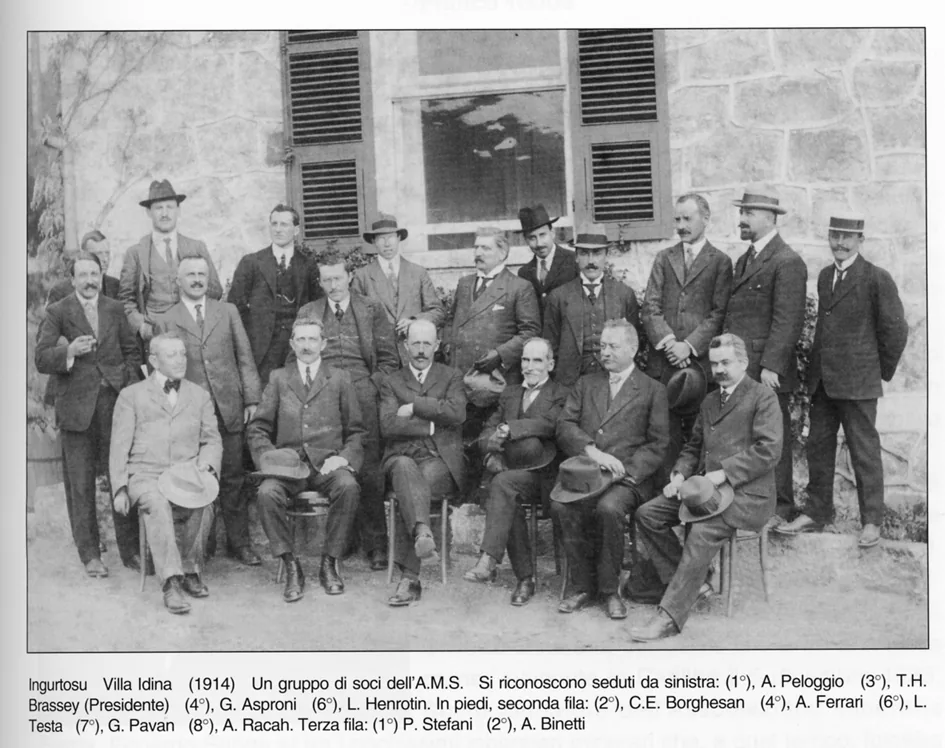
The other historical photograph shows members of the association in 1914, with Ingurtosu identified on the printed image. It does not portray a class of students or the institute's premises in Iglesias. Its relevance is institutional: the association supported the school and donated land for its new building. Stating the location and subject prevents an old photograph from becoming an attractive but misleading substitute for evidence.

A history also preserved in records
School archives make it possible to investigate people and practices beyond official portraits. A register, an examination file or an administrative document can answer questions different from those suggested by a façade. Who could attend, what stages did they need to complete, and how was teaching organised? An educational history develops through connections between these scales, rather than simply listing the successive holders of senior positions.
For visitors to Iglesias, the Asproni Institute therefore provides a place from which to consider how technical knowledge was passed on. Before planning to enter, consult Iglesias Turismo and distinguish school activity from museum services. Other articles in the Iglesias blog collection explore different places. Here, the central relationship is between technical education, local support and a building whose identity expresses its purpose of preparing people for professional work.