
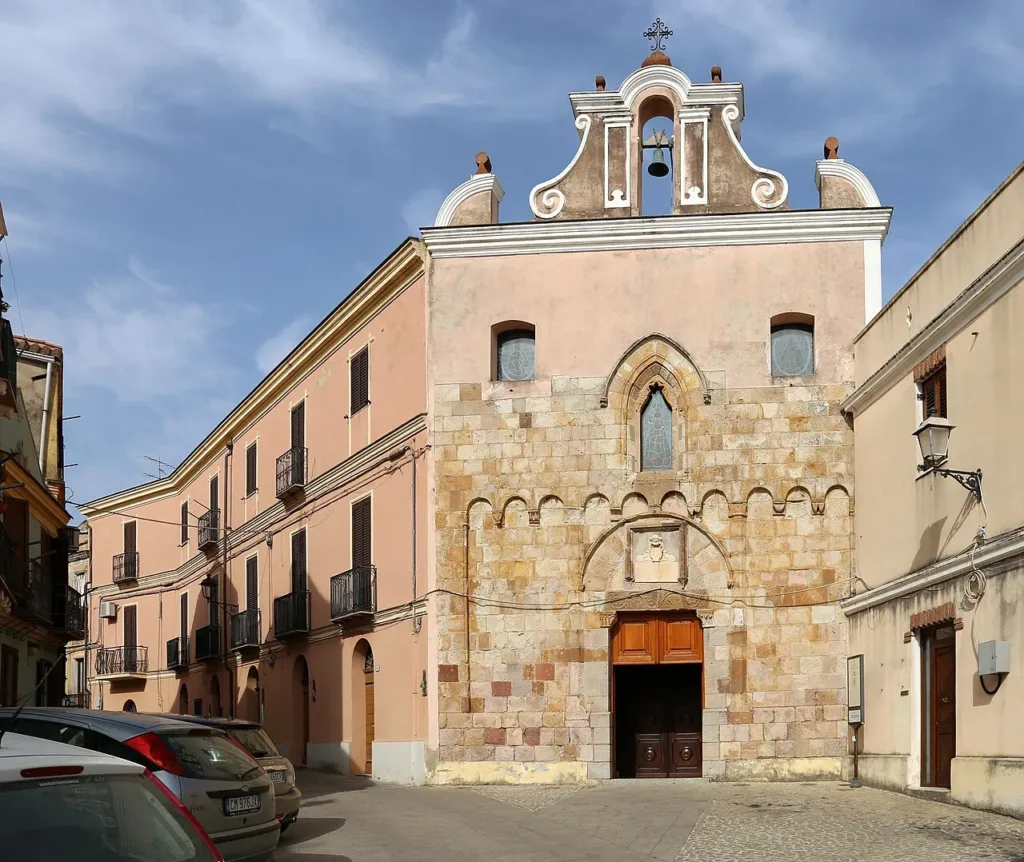

On Piazza Alessandro Manzoni, the Madonna delle Grazie church has an immediately recognisable façade: exposed stone below, a pointed window at its centre and a rendered upper section with bells and curved decoration. The photograph taken in 2019 allows these elements to be distinguished without assuming that they all belong to the same building campaign. The sanctuary preserves evidence of successive alterations, religious communities and devotional practices developed over a long period.
The Madonna delle Grazie sanctuary directory entry locates it in Iglesias. Its interest extends beyond the age of its walls. This is a place where the memory of a women's religious community meets a vow made on behalf of the town. Moving from the façade to individual objects and written records helps explain the relationship between the building and the people who have used it.
Before the Marian dedication
The church was originally dedicated to San Saturno. SardegnaCultura places its Gothic phase in the late thirteenth century while stating that surviving evidence does not establish an exact construction date. It is therefore more accurate to identify a medieval phase through architectural analysis than to give a precise foundation year. The later Marian dedication also shows how a building's religious identity can change while parts of an earlier structure remain in use.
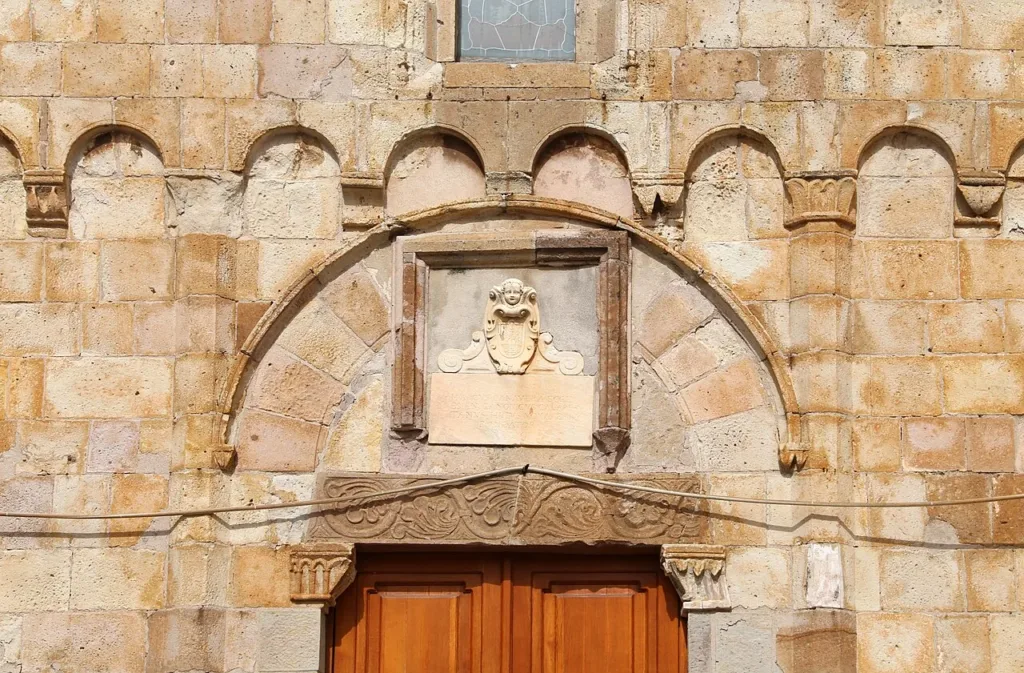

The close-up photograph of the entrance shows the large arch above the door, the carved lintel and an inscribed panel with a coat of arms. The municipal guide connects the inscription dated 1620 with Canon Marco Canavera and the establishment of the Poor Clares' monastery. The doorway can therefore be read as a collection of different kinds of evidence. Carved ornament and a written commemoration occupy the same area while communicating different information.
Evidence of the Poor Clares
According to the city guide, the monastery was suppressed in the late nineteenth century. The national sanctuary association's directory describes a grille with a small opening in the second bay on the left, used for the nuns' communion. This detail helps explain how architecture mediated between enclosure and worship. Participation in the liturgy did not necessarily mean following the same routes or occupying the same part of the church as other worshippers.
In its presentation of a cultural project in 2025, the Diocese recalls the succession of the Poor Clares and Capuchins as custodians of the sanctuary. The project involved museum, archive and library collections, including gifts offered by devotees for the statue's clothing and adornment. This reveals a history made through objects and people as well as stone. Garments and ornaments can record devotional relationships that continue across different generations.
Looking along the nave
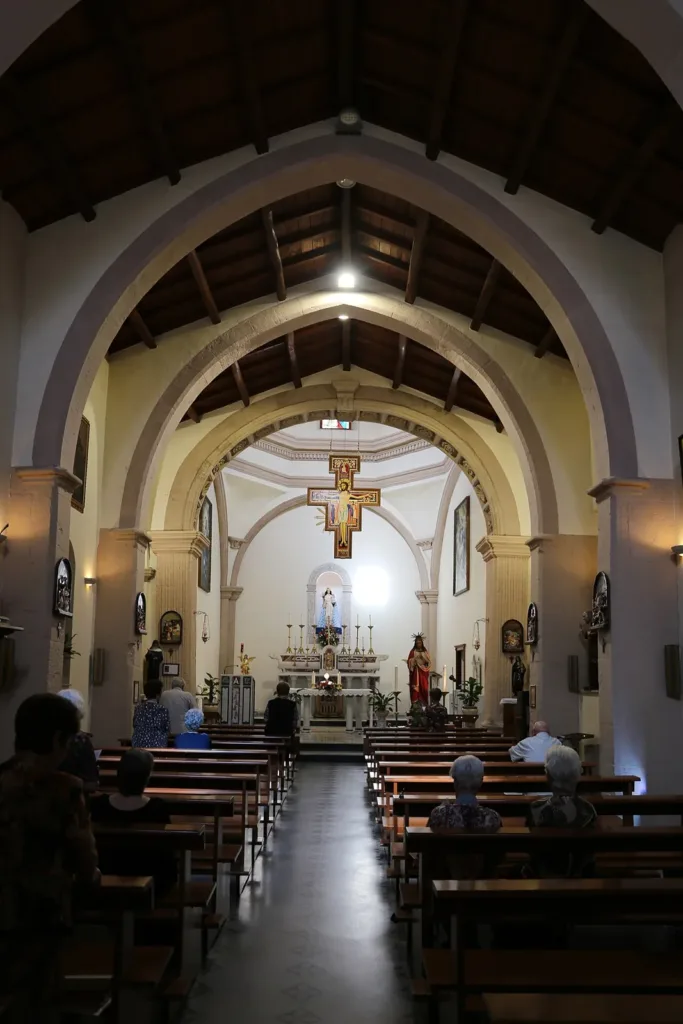
In the interior photograph, pointed arches mark the route towards the presbytery, with the timber roof remaining visible above them. Their repetition gives depth to the room, while the pews indicate its continuing liturgical purpose. SardegnaCultura describes a single nave divided into six bays. Looking at the relationship between these supports, the roof and the far end of the space provides an introduction to the structure before examining individual furnishings.
The Marian statue requires a separate reading from the building itself. National catalogue record 2000030198 identifies a Madonna and Child in carved and painted wood, proposing a date between 1690 and 1710. It also records differing attributions to Sardinian and Spanish workshop traditions. These are art-historical assessments rather than the identification of a named sculptor. They are also a reminder that an object inside a medieval church is not necessarily medieval itself.

A vow remembered by the community
The same catalogue associates the devotion with the vow made on 25 March 1735 by the municipal authorities and cathedral chapter during a locust infestation. Religious tradition understands deliverance from that threat as a grace granted by the Virgin. Distinguishing the recorded act of making the vow from its interpretation through faith allows both to be described respectfully. The candle offered by the mayor, noted in the sanctuary directory, expresses the public dimension of this remembrance.
The feast remains part of local church life. The Diocese preserves, for example, the homily delivered in the sanctuary on 13 July 2025. That record documents a past celebration; it does not determine next year's programme. Before visiting, consult the current deanery Mass information and sanctuary notices. During services, give worshippers space and leave closer observation of the furnishings for a time compatible with the building's religious use.