
Automatically translated from Italian.
Located in the rural heart of Sulcis Iglesiente, Nuraxi Figus has a few hundred souls, silent roads and the scent of the sea a few minutes drive. At first sight, this small town appears as a keeper of an ordinary quiet. Yet, under the light steps of those who cross this land, there is an extraordinary secret. In the dark of the subsoil a fossil forest remains intact for 310 million years, that time and pressure have transformed into black stone and coal. The fossils and prehistoric nature of Nuraxi Figus are not simple finds: they are living fragments of a geological eternity that began long before man moved the first steps on the planet.
The Carbonifer in Sulcis: the breath of a lost forest
Imagine a boundless tropical, warm and humid plain, stopping at 300 million years ago. Instead of the Mediterranean maquis there were plant giants today extinct: tall equises such as palm trees and tree ferns so thick as to light the sun.
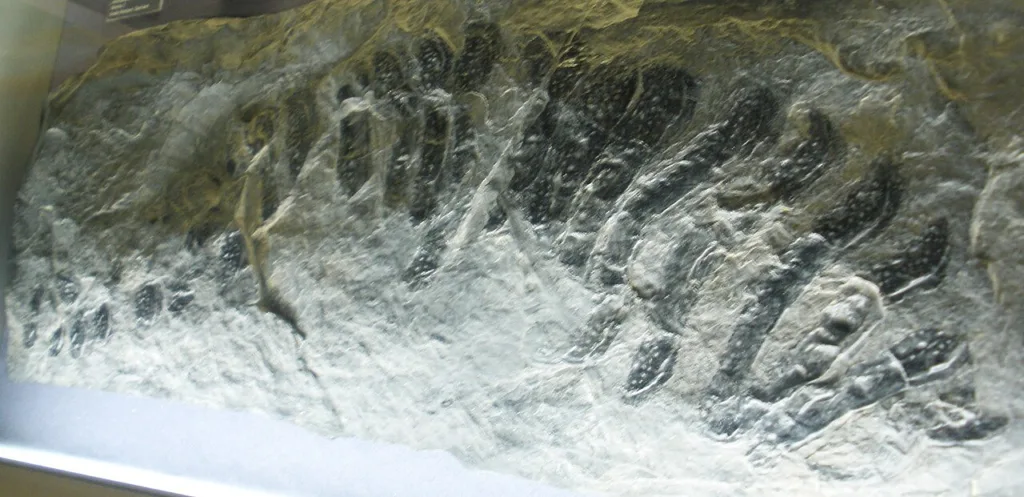
Up there flew dragonflies with seventy centimeters of wingspan. On the ground, on the other hand, the Arthropleura was crawling: a giant two-metre-long militia, real prehistoric colossus with vegetarian food. Right here, between Iglesias and Gonnesa, researchers from the University of Cagliari found a piece of its fossil armour. A crazy discovery for Italian paleontology.
Then, mud and sediment covered everything. Century after century, the compression of the earth sealed that immense jungle, transforming it into the only real coalfield in Italy: one hundred square kilometers of stone and energy buried in the darkness of Sulcis.
The mine of Monte Sinni: the last black fire keeper
The structures of Monte Sinni suddenly emerge at the gates of the country. It is the last outpost of Italian coal, finally extinguished in 2019.
The first excavations began in the 1930s, in the middle of the autumn, under the name Littoria Prima. Since then, managements, governments and flags have changed, but not the soul of those who descended into the wells. For generations – among fathers, children and grandchildren – the mine was a second skin, a whole family, well beyond the fatigue and bread. Today those structures rise in the sky as skeletons of industrial cathedrals. Quiet. Hard to explain to those who were not born here.
What to see between fossils and the prehistoric nature of Nuraxi Figus
The name of the village already says everything: in the Sardinian means "nuraghe dei fichi". The story here took root long before the man started looking for coal. If you enter the village, almost hidden among the pine trees, find the protonuraghe of Is Bangius, a massive and strange monument for this area. A little further there are the Holy well of Is Arenas and, climbing on the hill, the Domus de Janas of Serra Maverru. A true maze of archaeology concentrated in a few kilometers.
For those who want to reconstruct the geological history of this land, the map includes two mandatory stages.
In Carbonia, inside the old spaces of the Grande Miniera di Serbariu, there is the Museo dei Paleoambienti Sulcitani “E.A. Martel. This is where the collection explains the birth of Sulcis, with fossil logs and the reconstruction of the giant insect. The rarest original pieces and the samples of study of the flora of the Carboniferous are preserved in Cagliari, in the laboratories of the Museo di Paleontologia "Domenico Lovisato" of the University.
No tourist guide trick: Nuraxi Figus forces us to look at Sardinia from a different perspective, reminding us that our future rests on a deep rock three hundred million years.
On the cover: Fossil of Arthropleura via Wikimedia Commons (CC0 1.0 Universal / Public Domain).