
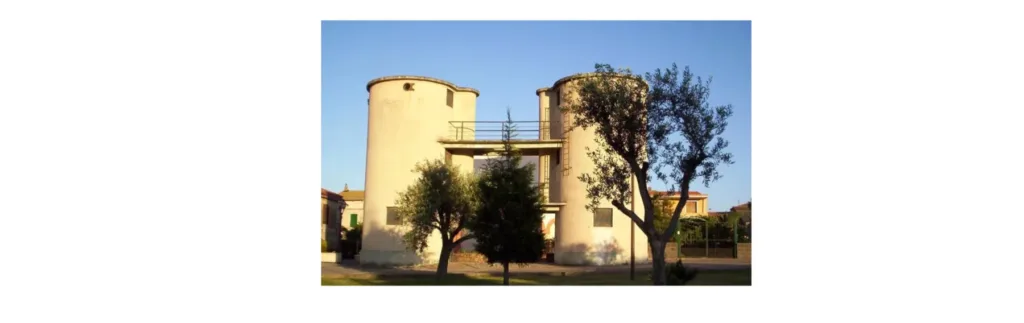
In Musei, the name Parco ETFAS preserves a history older than the concerts and public events held there. It points back to the transformation of Sardinian agriculture after the Second World War, when reorganising farming also required buildings and shared services. The silos photographed in the complex make that connection visible. Their distinctive volumes offer a way to understand the village through twentieth-century infrastructure, following the relationship between an original agricultural purpose and the public uses that developed later.
Understanding the initials ETFAS
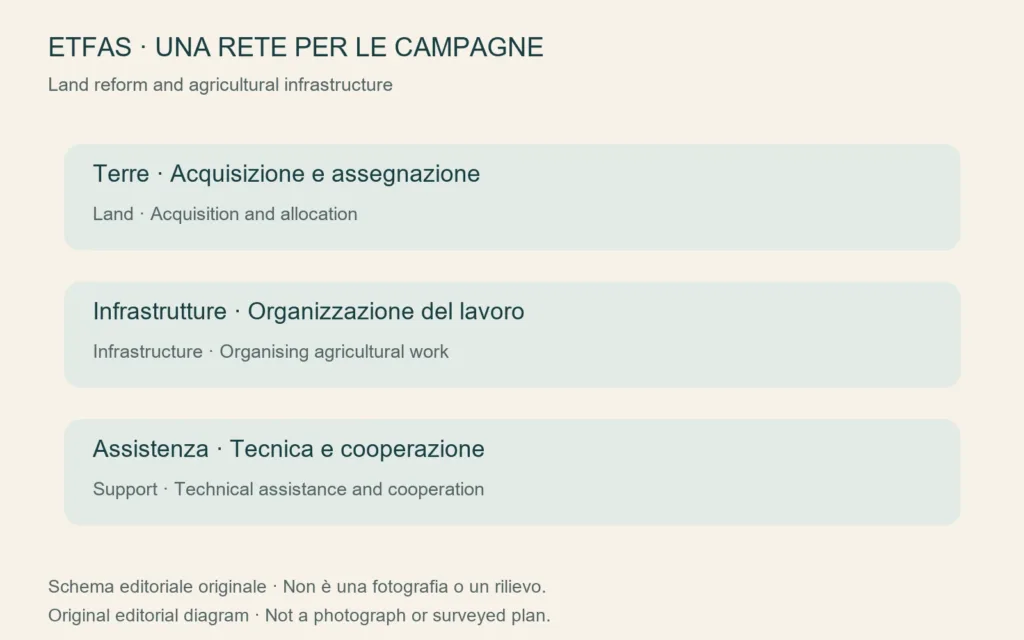
ETFAS stood for Ente per la trasformazione fondiaria e agraria in Sardegna, the body responsible for land and agricultural transformation in Sardinia. The SIUSA archival inventory dates its establishment to 1951 within the land reform programme. Its activities included acquiring and allocating land, creating infrastructure, providing technical assistance and supporting cooperative organisation. This wider context helps explain why the institution's name remains attached to a settlement and a public park in Musei, long after the original administrative arrangements changed.
Land reform involved more than drawing new boundaries around farms. Growing crops, keeping produce and organising work also depended on practical facilities and recognisable meeting points. A silo therefore invites questions about the surrounding agricultural landscape: fields, access routes and connections between holdings. Reading the building through its function prevents us from mistaking it for an ornamental tower. It does not, however, justify inventing storage capacities, particular machinery or specific crops where the consulted records supply no such information.
A silo dated to 1954
Italy's General Catalogue of Cultural Heritage records an asset in Musei called Silos Borgata ex ETFAS and dates it to 1954. The entry comes from regional cataloguing, identifies the structure as a silo and describes its ownership as belonging to a territorial public body. This provides a useful link between the building, its location and a particular year. The date applies to the catalogued asset; it should not automatically be assigned to every building or landscaped area now associated with the park.
The photograph published by the municipality shows pale cylindrical structures, an elevated connection and trees nearby. These visible features can be compared with the catalogue description without attempting an unsupported reconstruction of the interior. Looking at the external forms, their openings and their relationship with the surrounding open ground is already an informative exercise. The photograph records a particular view, while the diagrams accompanying this article summarise documented historical relationships. Neither should be confused with an architectural survey or an illustration of machinery known to have operated here.
Planning a new cultural role
A further stage appears in the regional resolution of 22 May 2008 concerning the Messaius network. Its list of interventions includes the recovery of Musei's former ETFAS architectural complex as a tourism and cultural centre. This is evidence of a reuse programme. On its own, it cannot date every completed intervention or establish the present arrangement of every room. It does nevertheless show that the proposed cultural role was tied to the recovery of an existing complex rather than the creation of an unrelated new landmark.
Reuse changes what people ask of a place. Spaces once connected with agricultural production can become somewhere to meet, hear music or participate in a public initiative. Continuity need not mean preserving every original activity. It can also mean allowing the complex's origins to remain understandable while new forms of occupation develop. In Musei, keeping the ETFAS name makes that transition easier to recognise, including for visitors who have never encountered the history of Sardinian land reform before arriving.
Finding the park in present-day Musei
The municipality's current places directory locates Parco ETFAS on Via dei Silos. The street name preserves the same material reference as the heritage catalogue. The council also advertised a Nomadi concert in the park on 1 August 2026. That announcement supplies a dated example of the site's use for live performance; it is not evidence of a permanent concert schedule. Anyone planning to attend a later event should check the municipality's current calendar and the organiser's practical information.
The Parco ETFAS directory entry provides a starting point for locating the destination. An architectural visit can focus on the relationship between the silos and the surrounding open space, without assuming that interiors are accessible. Entry arrangements during an organised event may differ from ordinary access. A place listing establishes where the park is, whereas the individual event notice is the appropriate source for admission arrangements and opening times.
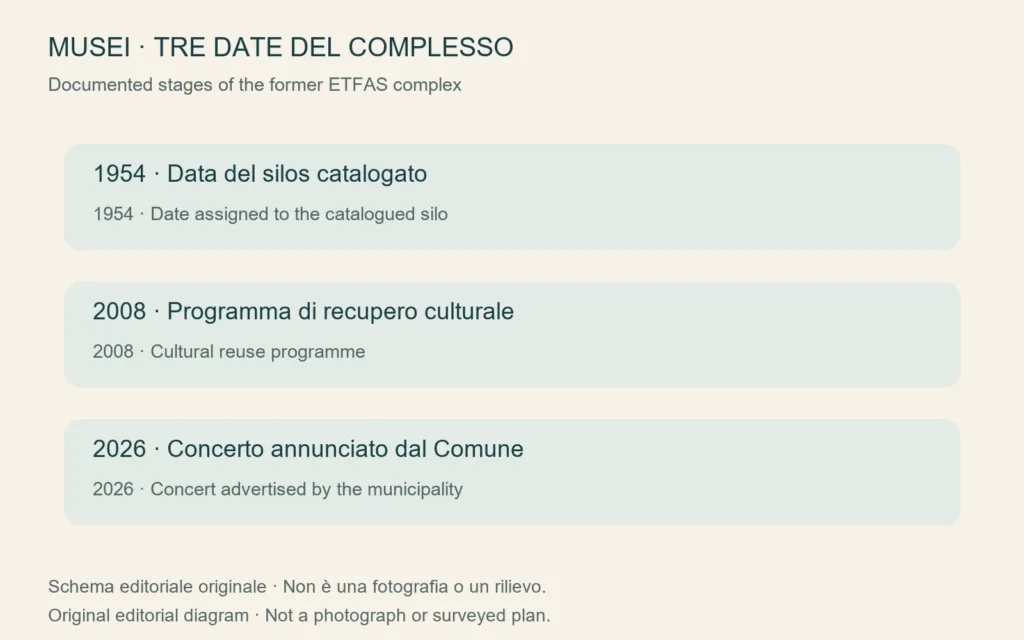
This stop offers a concrete encounter with modern rural history. The silo's catalogue date of 1954, the cultural project documented in 2008 and recent municipal events mark different stages in the life of the same complex. They do not explain every aspect of Musei. They do show how agricultural infrastructure can become a shared reference point, and why preserving a familiar name alongside the buildings can keep an otherwise easily overlooked part of local history in view.