
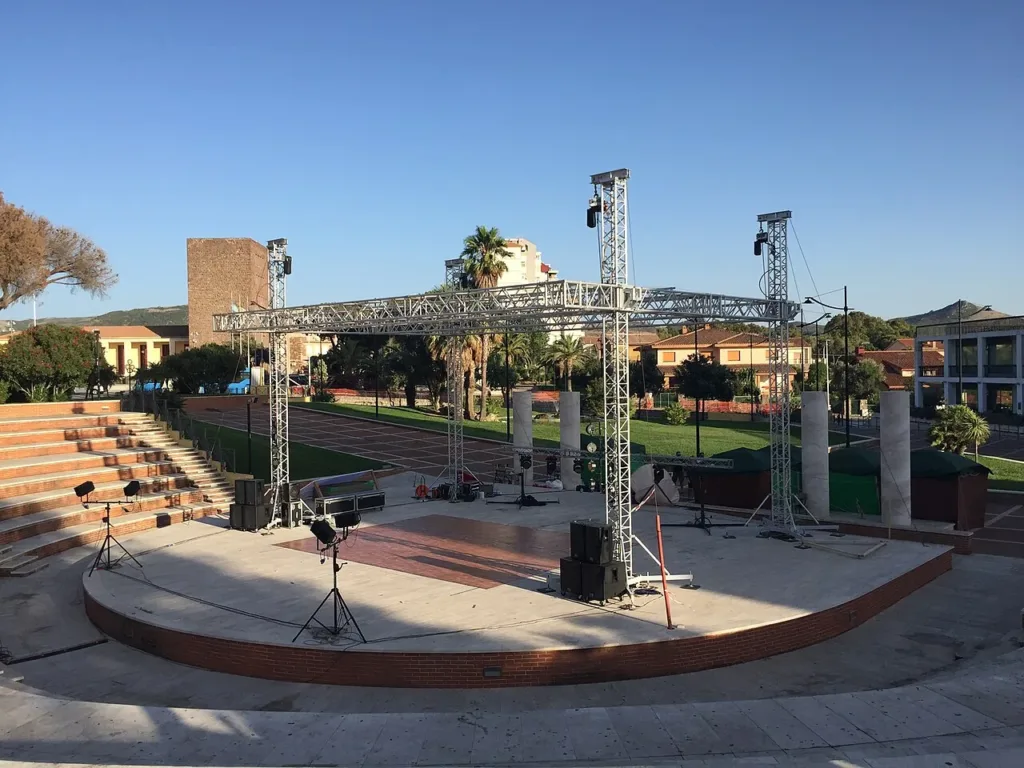

Piazza Marmilla offers a concrete way to understand how an urban space can change its role during the day. The amphitheatre's stepped seating directs attention towards a central area, while the surrounding spaces allow people to pass through and pause. When a performance begins, that arrangement becomes a relationship between audience and stage. At other times it remains an open part of the city, recognisable through its articulated shape and changes of level rather than through a scheduled event.
The Piazza Marmilla directory entry locates the complex in Carbonia, near the civic centre. Its name should not be confused with Sardinia's historic Marmilla region: here it identifies an urban square. Understanding it does not require repeating a tour of the other central monuments. The subject is the contemporary amphitheatre and its public space, approached through two dated photographs and municipal documents recording uses and interventions around the area.
Steps that organise a shared view
The August 2015 photograph shows a performance setup, with metal structures, equipment and a stage area occupying the centre of the amphitheatre. The permanent seating remains legible around this temporary apparatus. Distinguishing the two is helpful: an established architectural form accommodates equipment that can be assembled and removed. The presence of a stage in one photograph does not establish that the same structure belongs to the square's permanent furnishings or will be present during a later visit.

The steps show how an audience can occupy different levels without entering an enclosed auditorium. Their orientation makes the intended focus of attention easy to understand. At the same time, the edges remain connected with trees, paths and nearby buildings. The amphitheatre's urban character comes from that continuity. A performance occupies a recognisable space, but does not entirely detach it from the city around it, where other activities and movement can continue beyond the audience area.
The towers and the built edge
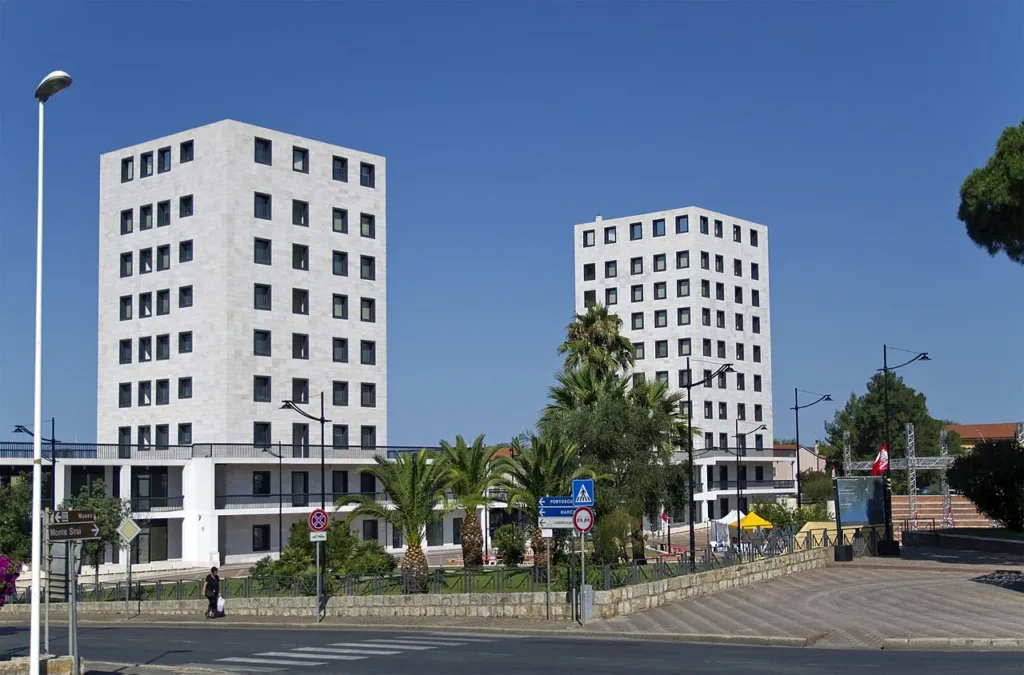
The second photograph, taken in July 2012, records the two towers facing the square's surroundings. Regular windows and pale volumes create a background quite different from the low succession of seating steps. The height of the buildings also makes the location recognisable from a more distant viewpoint. When reading the photograph, distinguish this built edge from the performance space itself, rather than assigning the towers a theatrical function simply because they appear close to the amphitheatre.
The two views therefore explain complementary relationships: one looks into the audience arrangement, while the other shows the connection with streets and buildings. For a photograph of your own, decide which relationship you want to describe instead of trying to include every feature in one frame. A detail of the seating communicates a place to pause; a broader view explains how the amphitheatre belongs to an urban environment that is inhabited and used even without organised events.
Documented performances and ceremonies
The municipality identified Piazza Marmilla as a venue for concerts and live performances in summer 2025, accompanying the programme with temporary traffic arrangements. That document demonstrates a specific use on particular dates; it is not today's events calendar. When planning an evening, check the current programme and any traffic notices. The square can keep the same name while access arrangements and temporary installations change from one initiative to another, according to the requirements of the event.
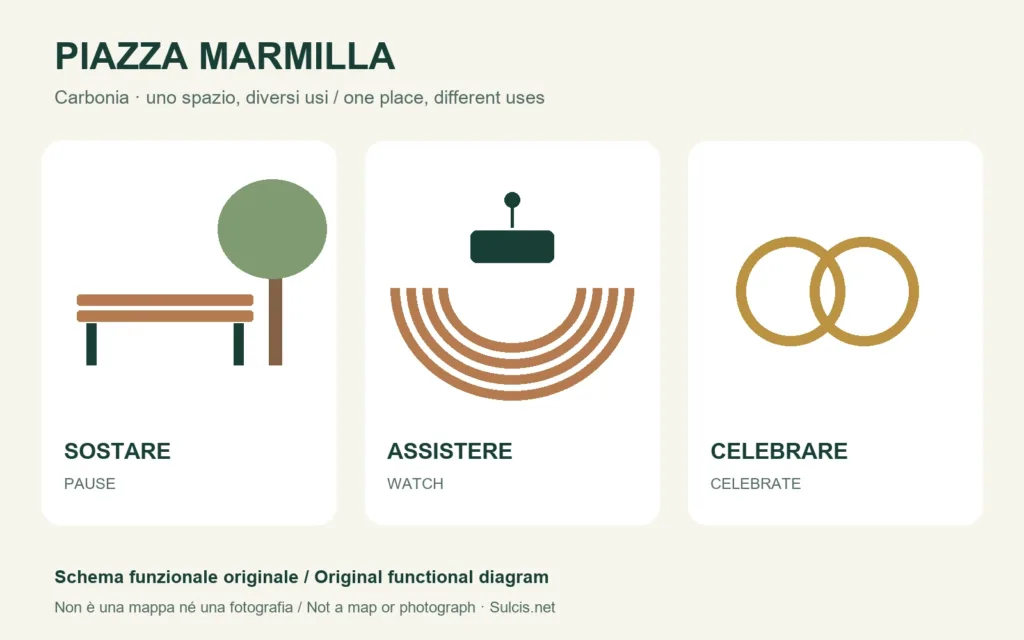
A municipal application form also documents the use of the amphitheatre for civil weddings. Hosting a ceremony adds another possibility alongside everyday use and performances, but requires arrangements with the administration: an empty square is not a confirmed booking. The original diagram included here summarises these three functions, pausing, watching and celebrating. It is a functional infographic, not a map, measured plan or photographic reconstruction of an event, and its simplified panels should be read accordingly.
A space that continues to change
The municipal page on the renewal of Via Manno, published in 2025, places Piazza Marmilla within a wider programme of central-area improvements begun in the early 2000s. It also describes work on the pedestrian perimeter towards the junction of Via Ala Italiana, Via Verona and Via Fosse Ardeatine. These are project descriptions. The page alone does not establish that every operation has been completed; actual access depends on conditions and signs encountered at the location.
A visit can be brief, but separating three layers makes it more informative: the amphitheatre's form, its use at that moment and changes to the surrounding area. Mixing them together can turn a temporary installation into imagined permanent architecture or a proposal into an assumed completed intervention. Keeping them distinct makes Piazza Marmilla easier to understand: a place where the same steps can support a quiet pause, an attentive audience or a community gathered for a ceremony.