
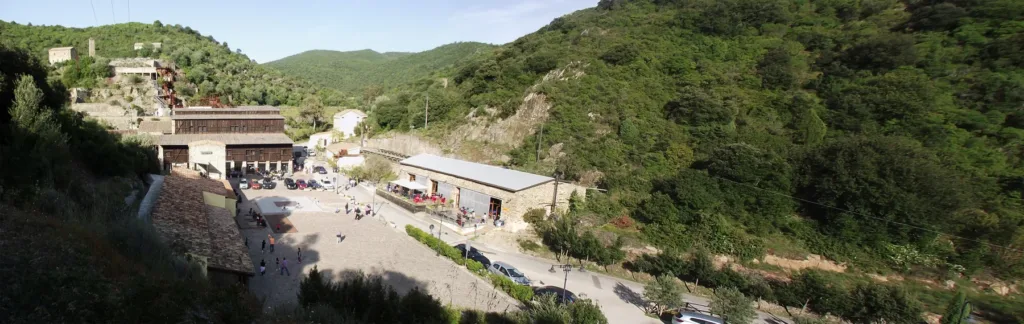

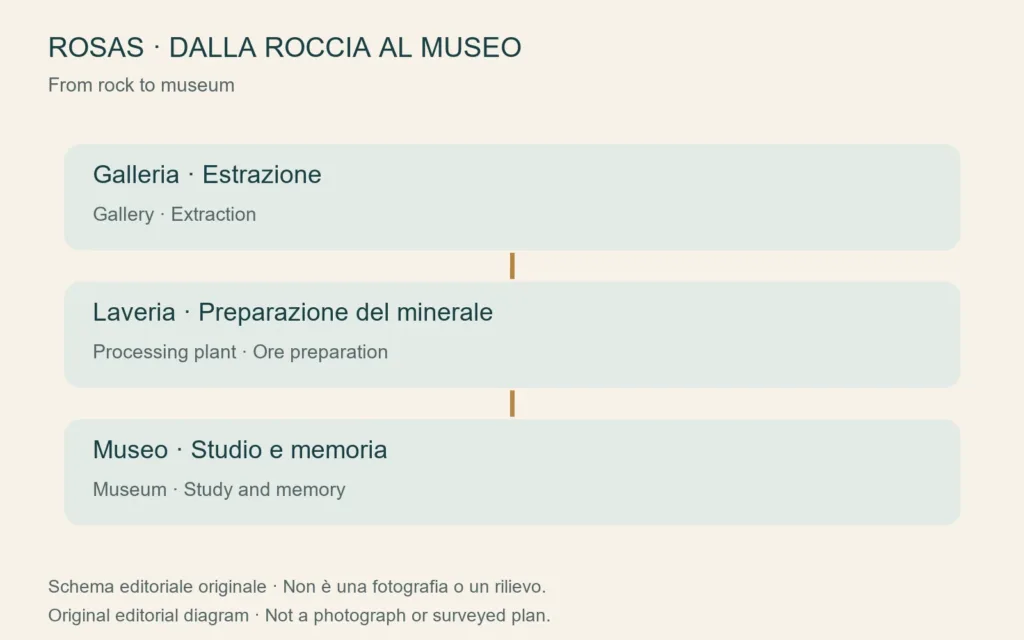
Rosas mine, in the municipality of Narcao, lets visitors follow a material through several different settings: the underground workings where it was extracted, the installations that prepared it and the museum cases where it is now studied. That continuity makes the complex rewarding even without a background in mineralogy. A useful question to bring to the visit is simple: what happened to the rock after it left the tunnel? Following the answer connects buildings and objects that might otherwise appear to be isolated industrial remains.
A concession and a changing enterprise
The Geomining Park records an 1851 concession to exploit galena, granted to the Società Anonima dell’Unione Miniere Sulcis e Sarrabus. In 1900 the concession was extended to zinc and copper minerals. These dates concern different developments: the legal establishment of the enterprise and an expansion of the resources it could exploit. They do not imply that every surviving building was constructed at once, or that processing methods remained unchanged throughout the mine’s working life.
The end of operations also needs careful wording. The Park separates the cessation of activity in 1979 from the final relinquishment of the concession in 1984, while the regional museum account gives 1980 as the closure date. It is therefore sensible to place the shutdown around the transition from the 1970s to the 1980s and distinguish it from later administrative steps. Industrial dates can describe different stages of a process rather than one decisive day shared by every source.
The processing plant and the journey of the rock
The laveria, or ore-processing plant, connects extraction to the preparation of the material. The regional account describes large surviving mills and multimedia spaces preserving miners’ testimony. Looking at a machine alongside an explanation of its use changes the scale of attention: from the size of the installation to the tasks involved in feeding, monitoring and maintaining it. Photographs document the complex, whereas the diagrams accompanying this article are original explanatory graphics, not technical drawings of the machinery.
The Santa Barbara gallery adds an underground dimension to that reading. Regional museum information presents it as a way to understand the working conditions and systems of a metal mine. Confirm the actual itinerary with the museum: an installation appearing in a general description is not a promise that every space will be open on every visit. The Rosas mine directory entry locates the complex in Narcao and provides a geographical reference for planning the journey.
From mineral specimen to laboratory
The Historical and Geo-Mineralogical Museum, established in 2016, identifies its current premises as spaces beneath the old processing plant. Its collections place local minerals alongside specimens from elsewhere. The comparison matters because a mineral name identifies a species, while a locality label tells us where an individual specimen was collected. Before treating a particular colour or shape as characteristic of Rosas, read the provenance on the display as well as the mineral’s name.
Objects documented by the museum include drilling equipment from different periods, laboratory instruments and material associated with the post office. Together they show that extraction depended on mechanical skills, measurement and communication. A typewriter and a drilling tool could belong to the same productive system despite having very different functions. Looking for those connections makes the collection more revealing than simply comparing the size, age or visual appeal of individual exhibits.
Why rosasite has its name
Rosasite is the clearest example of the connection between place and scientific discovery. The museum explains that Domenico Lovisato identified it in 1908 while examining material from the mine and named it after the locality. Containing copper and zinc, the mineral was subsequently found elsewhere. A discovery made in Narcao does not mean that every specimen now known comes from there. The museum also distinguishes the specimen examined by Lovisato, held in Paris, from the examples in its own collection.
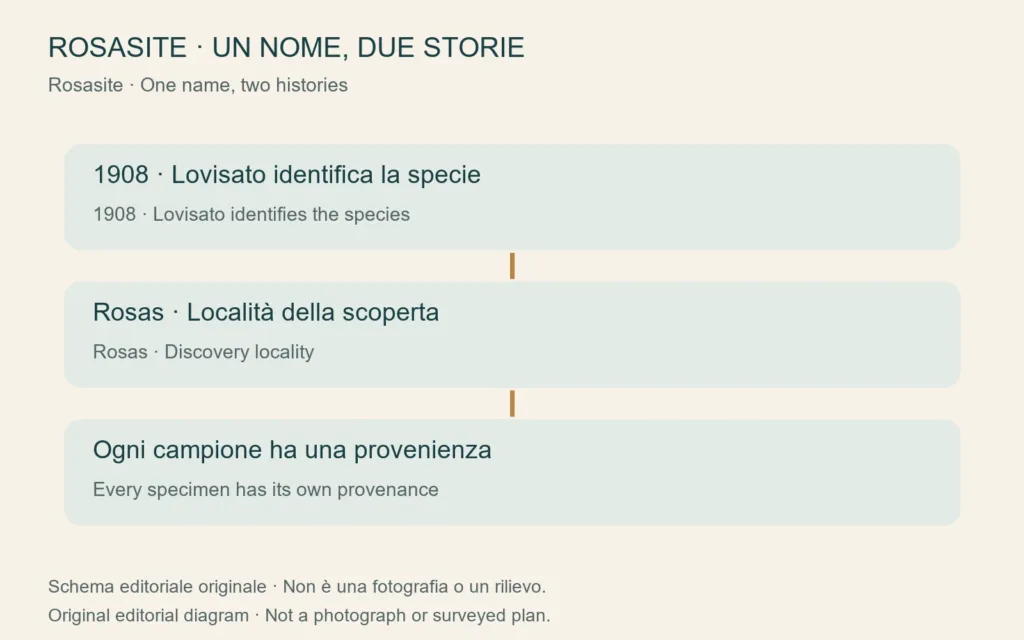
This suggests a practical way to read a mineral display: separate the history of the discovery from the history of the object in front of you. Ask which specimen established the species, where the displayed example originated and which properties support its identification. Such questions turn a case of colourful stones into an account of scientific investigation. They also avoid the assumption that a mineral can be reliably identified from a photograph alone, without its supporting information.
Planning a coherent visit
Before travelling, use the museum’s official website to confirm the tour time, included spaces and any individual access requirements. The consulted pages do not all show identical visiting programmes, so reproducing a timetable without context would be misleading. The strongest way to understand Rosas is to connect its plant, gallery and collections: obtaining a resource, investigating its properties and preserving the experience of the people whose work sustained the enterprise.