
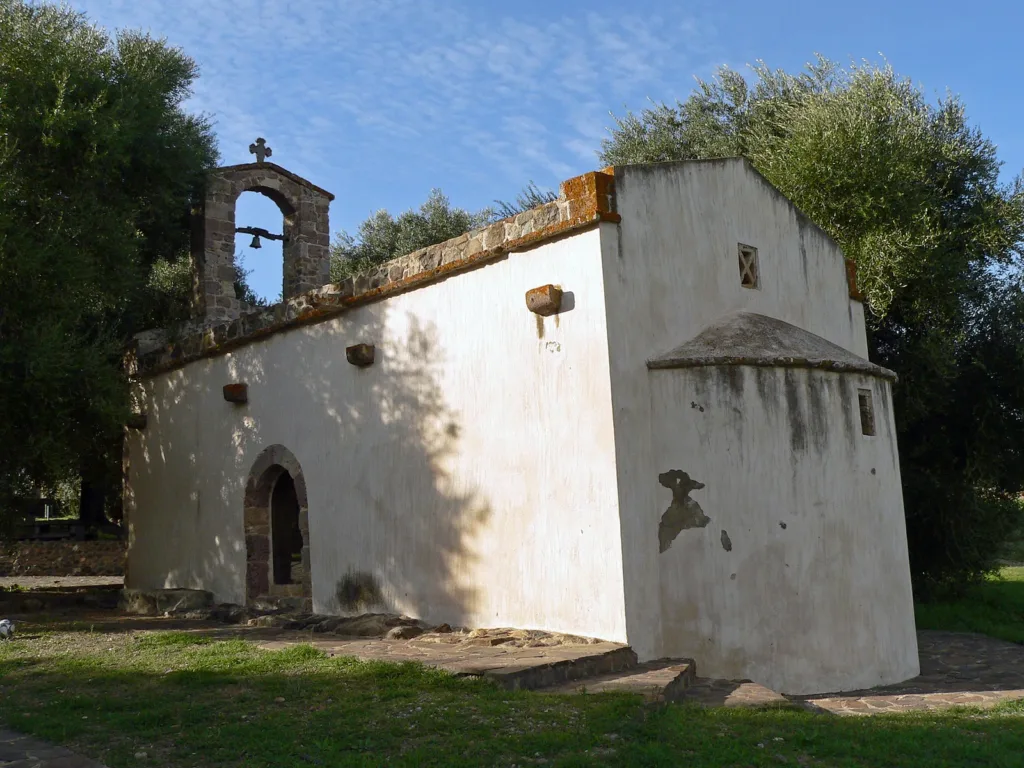

An olive trunk in front of the doorway and a pale wall seen from the side give two different impressions of San Leonardo. In the rural locality of the same name at Perdaxius, this small church rewards a change of viewpoint. Its front gathers stonework, openings and the bell-cote into a compact composition; its side reveals the length of the building and its relationship with trees. The surrounding park is more than a green backdrop: it shapes the way the monument comes into view.
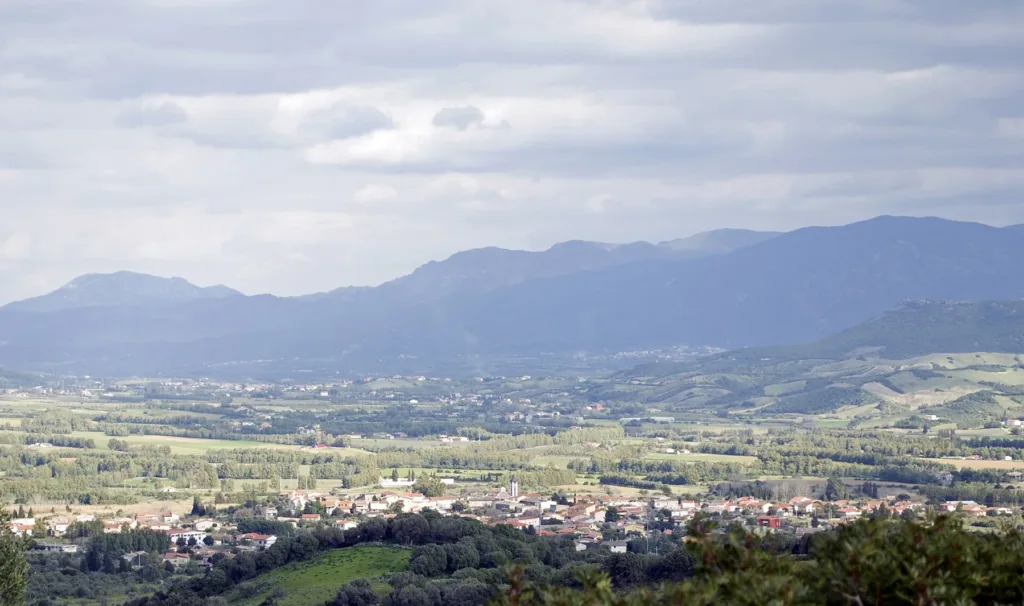
The San Leonardo directory page marks this particular church on the map. Use that precise reference, since churches dedicated to the same saint occur elsewhere in Sardinia. This article concerns San Leonardo at Perdaxius alone. The panoramic photograph shows the village and surrounding countryside. It provides territorial context without claiming that the church can be identified among the distant buildings, or confusing a general view with a detailed record of the monument.
Reading the front from ground to sky
In the frontal photograph, the arched doorway provides the first point of orientation. Above it are a small opening and the bell-cote, which continues the upward movement of the façade. This is not a separate tower: its visual weight remains attached to the wall below. The eye can follow a concentrated sequence from threshold to bell, without being directed by a grand decorative scheme, a deep porch or an arrangement of columns spreading across the front.
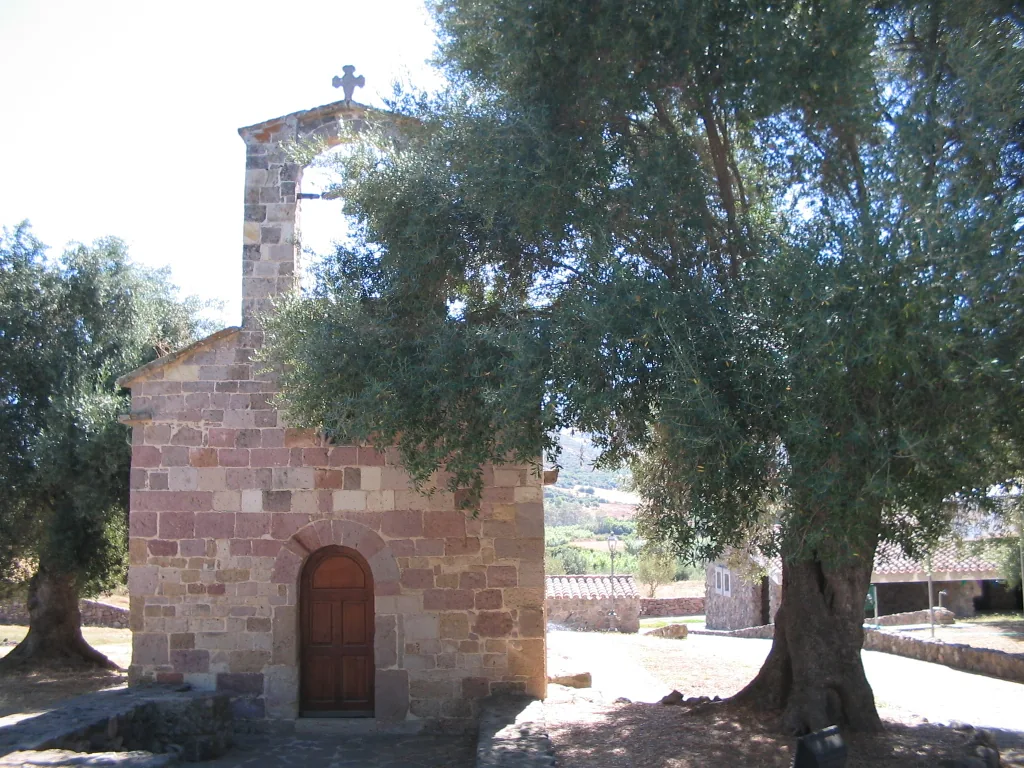

The stonework varies slightly in colour across the surface. Joints distinguish individual blocks, while the dark timber door makes the entrance stand out. An olive tree in the foreground interrupts a perfectly frontal reading and introduces another vertical form, irregular and branching. There is no need to assign the tree an exact age to appreciate that relationship. Its outline overlaps the church’s geometry, changing how the façade is perceived and reminding the viewer that the building occupies a living outdoor setting.
The side presents another aspect
The cover photograph chiefly shows the rendered surface of the long wall. Its contrast with the exposed stone front explains why both views matter. A single image could suggest either a church entirely faced with visible masonry or one wholly covered in render. At the rear, the projecting apse stands out from the long wall of the main body. It also provides a useful point of orientation, identifying the end opposite the entrance without relying on a plan.
These observations describe the appearance recorded in the photographs, rather than reconstructing the original finishes. The Ministry of Culture’s Idese record notes work on the render during restoration in the 1990s. The pale surfaces should consequently be considered alongside the building’s maintenance history. Seeing one exposed section does not establish that every wall was intended to look that way. The relationship between uncovered masonry and protected surfaces raises historical questions as well as producing the colour contrast visible today.
Different dates concern different phases
Idese assigns the church to the second half of the thirteenth century, while SardegnaTurismo mentions a seventeenth-century rebuilding of its façade. These statements should be read with attention to the parts concerned: a date for the front does not necessarily date the underlying arrangement. That distinction makes San Leonardo particularly worth examining. The face welcoming a visitor and the body extending behind it may express different moments brought together within the present building, rather than one unaltered construction campaign.
For further investigation, consult the Ministry of Culture record, which also identifies specialist bibliography. The photographs reproduced here do not document either the medieval construction process or the later rebuilding. They show what survives. Reading them alongside historical sources prevents a single date from being applied indiscriminately to every stone. Even an apparently straightforward church can contain evidence of construction, transformation and subsequent care, with each process contributing to the appearance encountered in the present.

Planning a stop in the park
The ministry record describes the church as visible from outside. Plan the stop around its exterior and establish separately whether the interior will be open. Visitors with mobility requirements should ask about the approach: the same record identifies accessibility as partial. The presence of a green space does not establish that every section has an even surface or that all sides of the building can be reached in the same way. Those practical conditions deserve confirmation before a journey.
The Perdaxius panorama broadens the view at the end of this visual journey. Houses, fields and hills place the small religious building within inhabited, cultivated territory. Returning to the closer photographs, the park becomes a setting in which to distinguish front from side, stone from render and one historical phase from another. San Leonardo offers a focused encounter with those differences. Its interest lies in looking carefully at a modest structure, allowing the surrounding olive trees and open space to remain part of the reading.