
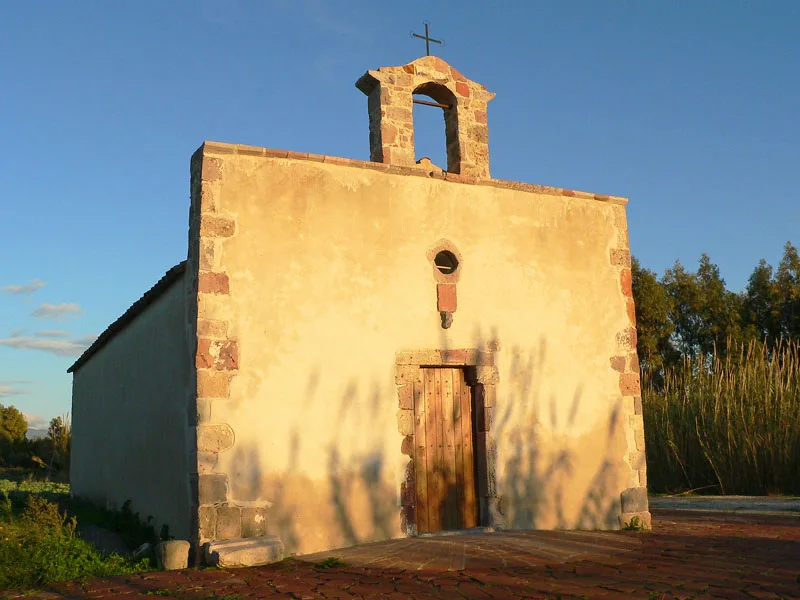

Santa Marta church, near Villarios in the municipality of Giba, invites a slower kind of looking. From a distance, its small rendered volume, almost rectangular front and bell gable dominate the view. Closer attention shifts towards a handful of stone details around the entrance and beneath the upper opening. Small as they are in relation to the façade, these features change how the building can be read. An apparently plain surface contains individual marks and projections worth examining in their own right.
A medieval church in the Villarios area
The Union of Sulcis Municipalities places Santa Marta in the eleventh century and associates its construction with Benedictine activity. Sardinia's regional tourism portal cautiously suggests a date around 1066. Neither statement amounts to a complete chronology of the surviving fabric. They establish a medieval context, but do not allow the plaster, doorway, bell support and every visible carved stone to be assigned automatically to one building phase.
Its location near Villarios is also essential for distinguishing this building from other churches dedicated to Saint Martha. The settlement's history and relocation are addressed separately in the article about Villarios and its rebuilt centre. The subject here is deliberately narrower: recognising the character of this place of worship through its front and understanding what photographic evidence can actually show.

Begin with the doorway
In the photographs, exposed stone elements frame a wooden door. Their contrast with the surrounding render makes the edges of the opening and the lintel above it clearly readable. There is no need to imagine an elaborately decorated front throughout. The interest lies in the concentration of worked stone at particular points. The threshold organises the elevation while providing a human scale against which the rest of the wall can be considered.
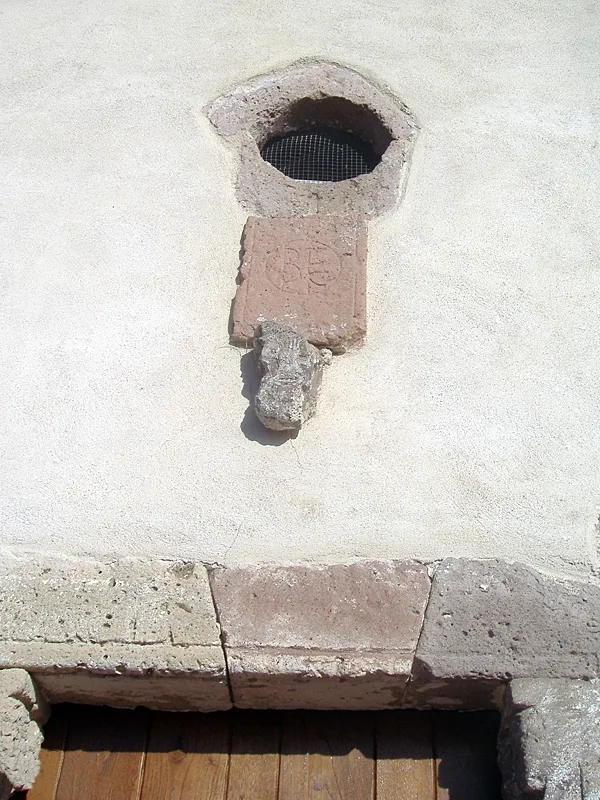
A small circular opening appears higher above the entrance. Its stone edge remains distinct from the plaster, and beneath it a reddish slab and a projecting carved element can be made out. The detail photograph connects these components instead of presenting them as isolated objects: opening, slab and carving occupy the same vertical line. A close view is valuable precisely because it reveals relationships that become difficult to recognise in a general photograph.
Incised marks and a carved face
Incisions are visible on the slab, while the projecting form below suggests a face. The Wikimedia Commons photograph has a Benedictine reference in its file name, but a photographer's title is not proof of what a mark means. Three levels should remain separate: what the image shows, the name assigned to the image and a historical interpretation of the object. Only a specific supporting study could confidently identify an emblem, establish its function or assign a date.
One way to examine the face is to follow the transition from the flat slab to the projecting stone. Side lighting emphasises raised surfaces and creates shadows within recesses, making the detail more or less legible according to the conditions of the photograph. Two views of the same feature can therefore look different without necessarily recording a material alteration. Neither image, by itself, tells us the sculptor's name or identifies a person who might have been represented.
Render, corner stones and the roofline
The oblique view shows a side wall extending behind the front and a sloping roof beyond its upper edge. Exposed blocks mark the corners, while broad areas remain rendered. This relationship between surface covering and visible stone belongs to the appearance documented in the photographs; it cannot independently establish the original finish. Similarly, the warm colour of the cover image reflects its lighting conditions and should not be treated as a calibrated record of the masonry's colour.
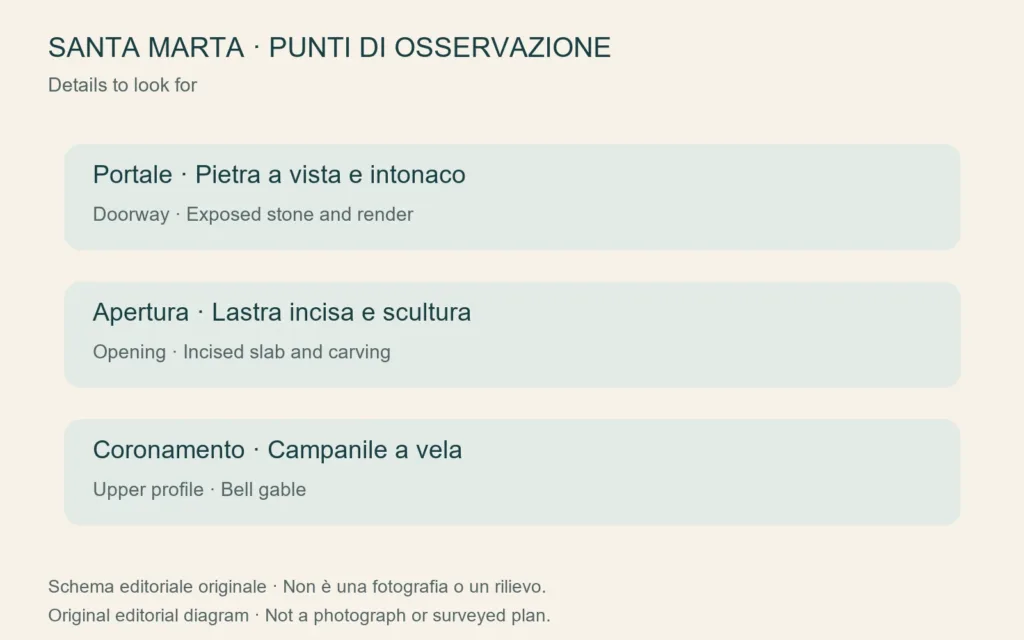
A bell gable completes the front with a small open structure. Unlike a tower, it accommodates a bell within the thickness of a projecting wall. In the selected photographs, its silhouette is particularly important in making the building recognisable as a church. The original editorial diagram gathers these observation points together. It is a conceptual reading aid, not a measured survey or an attempted reconstruction of the medieval building.
Approaching Santa Marta with precise expectations
The directory's Santa Marta entry locates the monument within Giba's territory. Before planning to enter, seek local information: inclusion in a tourism directory does not constitute an opening schedule. The photographs reproduced here record the building at the time they were taken. They do not certify the present condition of every wall surface, stone or opening.
A rewarding reading of Santa Marta can remain focused on only a few features: the entrance, the upper opening, the incised slab and the carving. Considering how they relate allows the monument to be appreciated without filling gaps in the evidence with invented stories. Its medieval origins provide the broader setting. The surviving surfaces raise smaller, more exact questions, to which conservation records, documentation and further study may gradually provide firmer answers.