
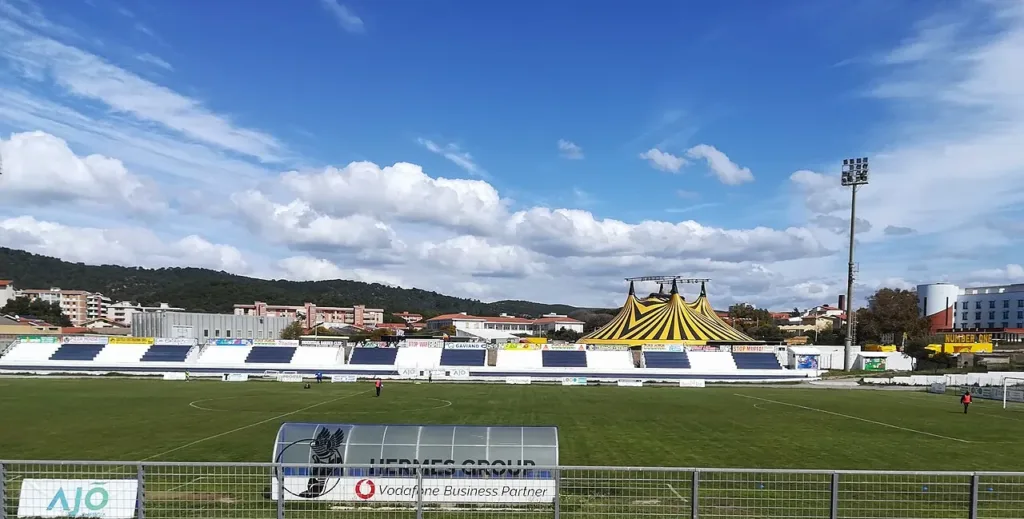

A broad arch facing the street, a metal roof above the seating and a green rectangle beyond the entrances: Carlo Zoboli Stadium offers a sporting perspective on Carbonia. You do not need to recognise a historic team photograph or remember a particular score to understand its interest. Start with the building, the relationship between players and spectators, and the people whose names the town has chosen to associate with it.
The stadium entry in the directory identifies the ground on the map. Italy's General Catalogue of Cultural Heritage records its address as Via della Stazione 19, Carbonia. That locates the building, but a match ticket may require a particular entrance. Check the access instructions for your section, since a sporting venue can have several gates and different circulation arrangements depending on the event taking place.
A ground designed for several sports
The municipal documentation for Monumenti Aperti dates construction to 1939-1940. The original programme brought together football, jumping events, basketball and running within a masonry enclosure. Thinking only of the football pitch would therefore leave out part of the design. It was a setting for different forms of physical activity, providing areas for competitors as well as stands from which an audience could follow what was happening.

This arrangement suggests a useful way of reading a newly built town. Collective time extended beyond work and needed places where people could gather around a shared activity. That is an interpretation of the sporting space, rather than a reconstruction of every household's routine. Establishing what happened during a particular season would require programmes, photographs and personal accounts specifically associated with that period of the ground's life.
Reading the stand from the street
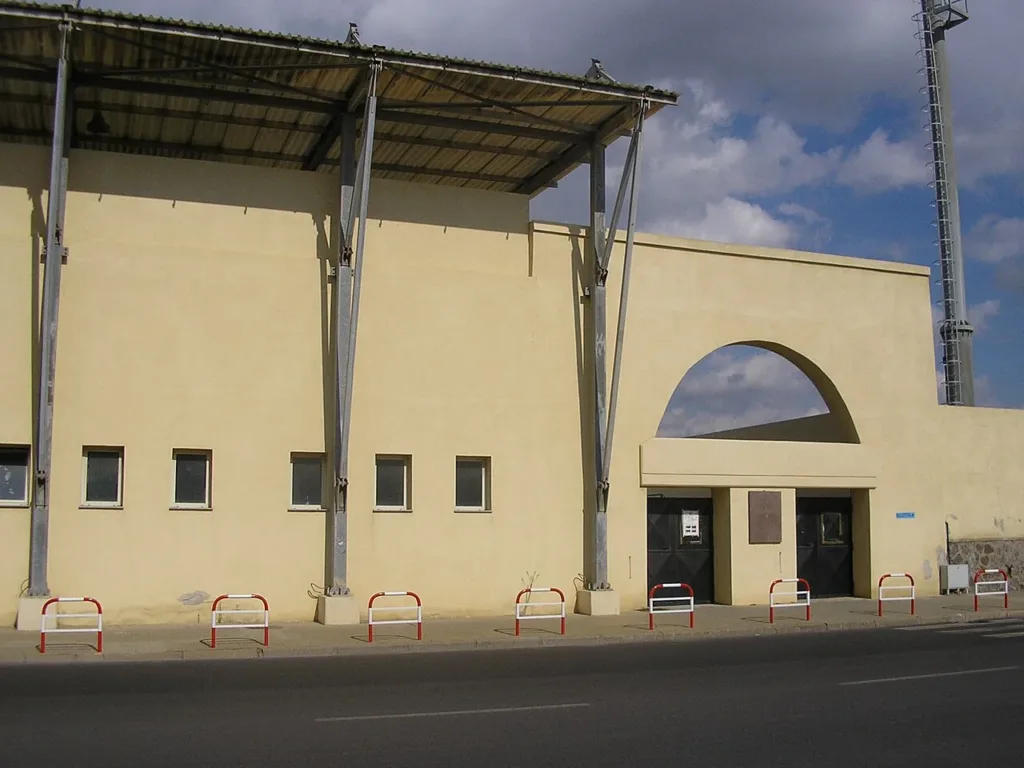
The entrance photograph, taken in 2007, shows a central arch and small openings placed regularly along the wall. Above them, the roof and its supports remain clearly visible. The image brings together two scales: an entrance sized for people passing through and a canopy sheltering a much larger seating area. From outside, the facade does not reveal the full extent of the ground, but it gives the point of entry a recognisable form.
The catalogue describes facilities and changing rooms beneath the seating and identifies the later roof as structurally separate from the stadium body. This distinction helps visitors avoid treating every visible component as part of a single building campaign. A ground used over many decades acquires alterations. Understanding its architectural history involves recognising those changes and the technical and practical needs to which they responded, alongside the features that remain from earlier phases.
Names that preserve sporting memory
The Municipality's 2026-2028 planning document records the dedication to Carbosarda player Carlo Zoboli on 9 September 2011. It also notes that the principal stand has carried the name of Stefano “Pepi” Gessa since 2022; the Carbonia player died during training in 1993. These are separate commemorations, one naming the entire venue and the other a particular part of it. Keeping them distinct makes announcements and directions easier to understand.
Such dedications turn a familiar place into a setting for remembrance. A first-time visitor encounters a history of people as well as walls, seats and playing surfaces. Paying attention to the names offers a direct introduction to the local meaning of sport, beyond league positions. It also leaves room for different memories: people who have followed the club for years will not necessarily associate the ground with the same match or experience.

Looking at the pitch and planning a visit
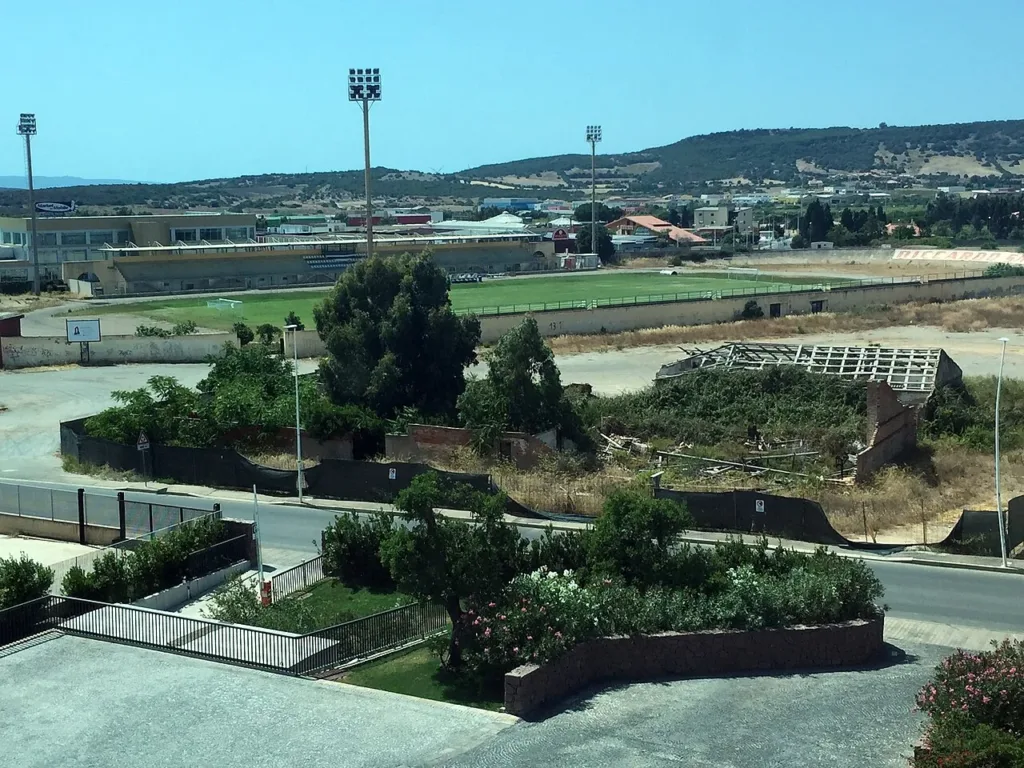
In the 2022 interior view, the playing surface fills the foreground while the opposite stand creates a horizontal boundary. The more distant photograph from 2015 places the stadium within the townscape and shows the space around the pitch. Each view answers a different question: what the field looks like from a spectator's position, and how the sporting complex fits into its urban surroundings.
These photographs document the dates given in their captions, rather than today's opening arrangements. Before travelling, find the announcement for the particular match and confirm the venue, kick-off time, ticket availability and section. The municipal sports regulation lists the Zoboli as an eleven-a-side football ground; it is not a fixture calendar. Questions about using the facility can be directed to the Municipality's sports facilities service. Looking at historic architecture and attending an organised event require different information, and checking the appropriate details makes the visit more useful.