
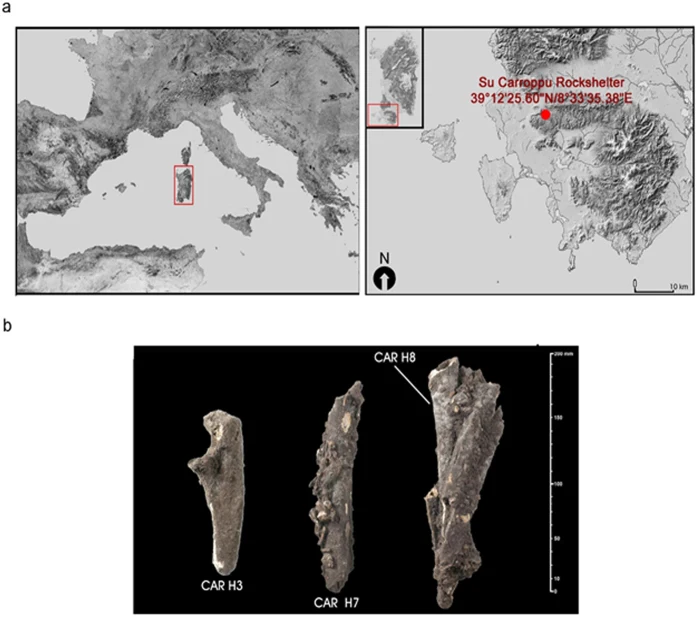
Su Carroppu is a rockshelter near Sirri, within the municipality of Carbonia. Its importance does not depend on monumental architecture. It lies in deposits that have preserved evidence of very early human activity. A natural shelter can hold a succession of occupations, objects and biological remains. Reading that succession means distinguishing different periods, rather than imagining a single settlement that remained unchanged throughout several thousand years of human history.
The Su Carroppu directory entry provides a geographical reference. This article concerns archaeological research and what published investigations help us understand; it does not describe an equipped walking trail or claim a personal visit. The nearby village name helps locate the site. Our subject is the shelter itself, and the questions it raises about human presence in Sardinia before and during the spread of farming communities.
A protected place with successive traces of occupation
The University of Cagliari describes Su Carroppu as a substantial shelter on a limestone spur, in surroundings with vegetation and water. The rock overhang offered natural protection, although that feature alone cannot explain every phase of use. Objects must be studied in their archaeological position. Finding two items close together does not, by itself, establish that they were deposited at the same time or used by the same people.
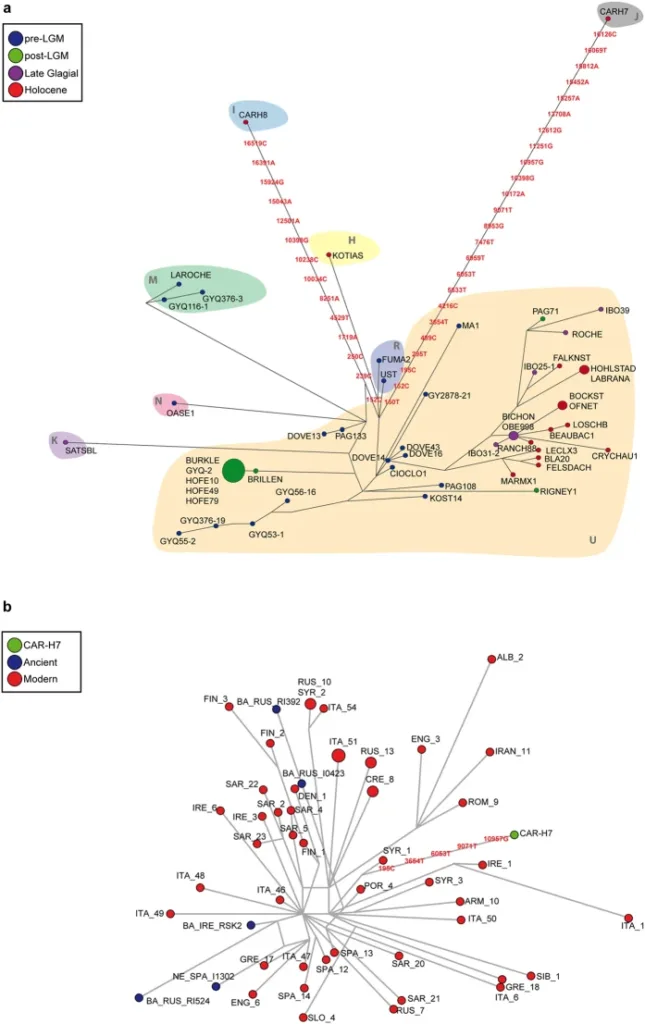
Investigation has a long history here. The university's account recalls Enrico Atzeni's work during the 1960s and 1970s and systematic excavations directed by Carlo Lugliè from 2009. Reassessment of earlier collections therefore accompanies new field campaigns. This illustrates something essential about archaeology: discovery does not end when an object is removed from the ground. New questions, comparisons and analytical techniques can change the interpretation of material that has already been collected.
Why different dates may describe different phases
A 2017 paper in Scientific Reports examines human remains from the lowest level excavated in 1978. Direct radiocarbon dating places them in the Mesolithic, before the site's Neolithic occupation. The shelter therefore preserves evidence predating farming communities. When an overview discusses Su Carroppu in the sixth millennium BCE, it may be referring to its Neolithic phases rather than summarising the entire history represented by the deposits at this particular location.
That distinction matters when apparently conflicting chronologies appear in introductory accounts. Dating a bone assigns a time range to that sample; it does not give every object from the site the same age. Equally, identifying a pottery phase does not rule out earlier human presence. The 2017 research and university reports on later fieldwork help separate these different questions. There is one geographical name, but the evidence attached to it belongs to multiple moments.
What ancient DNA adds to the investigation
The study samples three individuals but uses two sufficiently reliable mitochondrial sequences for subsequent genetic comparisons. The third sample is excluded from further analysis because of data quality. This distinction should survive the transition from research paper to public explanation: three sampled remains do not mean three validated results. The scientific illustrations reproduced here show the location, samples and comparisons. They do not reconstruct the physical appearance of the people who used the shelter.
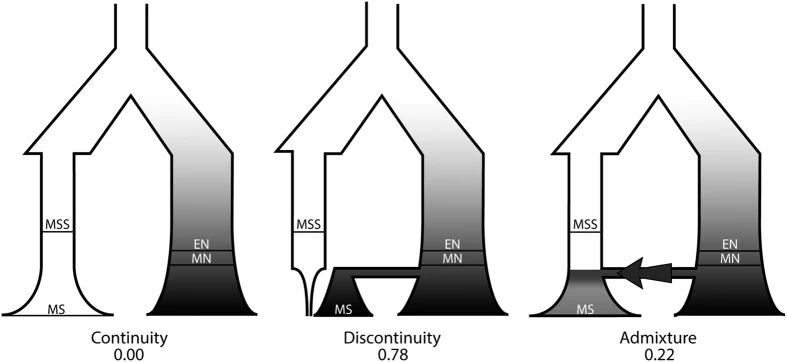
Mitochondrial DNA follows a particular line of inheritance and does not, on its own, represent a person's complete genetic heritage. The authors compare alternative models and explicitly acknowledge limitations in the available sample. Probabilities shown in the third figure belong to those simulations; they are not personal ancestry percentages to assign to present-day Sardinians. The investigation contributes direct evidence to a wider discussion while leaving a clear need for additional material and research.
Connecting an archaeological deposit with public understanding
For the Neolithic phases, finds from Su Carroppu also contribute to the account of the surrounding territory at the Villa Sulcis Archaeological Museum. The municipality's presentation places them among evidence used to explore changes in everyday life and communities. The museum provides an interpretative context for the objects, while the shelter retains the significance of their place of origin. These two perspectives support each other, but seeing museum material is not the same experience as entering an archaeological site.
Readers wishing to investigate further can begin with the scientific publications and ask the museum system about current opportunities for public interpretation. A point on a map does not certify access to an excavation area or establish that independent visits are permitted. Su Carroppu deserves attention because it shows how knowledge is assembled through field observations, samples, checks and increasingly precise interpretations. Its long history cannot be reduced to one striking date or a simple claim about the origins of an island's population.