
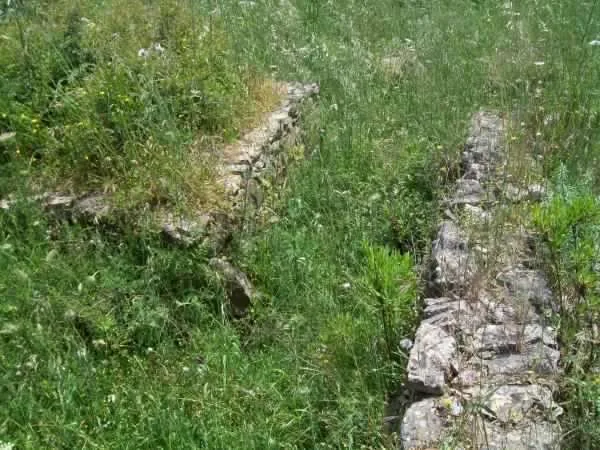

A figurine with outstretched arms and a few courses of stone can seem to tell stories about different places. At Terraseo, within the municipality of Narcao, they offer two approaches to the same question: how can a cult be recognised when much of its building has disappeared? At the sanctuary of Demeter and Kore, both structures and objects deposited within them matter. Separating these kinds of evidence helps explain what the photographs show and what needs archaeological interpretation.
The site lies at Strumpu Bagoi, near the hamlet of Terraseo; regional sources also use the spelling Terreseu. Our Demeter and Kore temple directory page places it on the Narcao map. The photograph of the site reproduced here dates from 2006. It records low remains among vegetation, rather than a reconstructed monumental building. The two photographs of figurines, by contrast, were taken in a museum display and should be read accordingly.
A harvest goddess in a Punic setting
The National Archaeological Museum of Cagliari describes Demeter as a Greek harvest deity whose worship was adopted by the Carthaginians. It identifies Narcao’s sanctuary as an extraurban place of worship that continued to be used in Roman times. The Greek name does not automatically make every phase of the building Greek. The movement of a cult between cultural settings is part of the site’s interest, and religious meaning needs to be considered alongside its material history.

For visitors, the first implication is to look beyond an expectation of columns and pediments. Surviving stones need not resemble the familiar image of a classical temple to have belonged to a sacred space. A more productive comparison connects the plan, the small rooms and the position of deposits. The question becomes less about the grandeur of a façade and more about the traces that allow researchers to recognise actions repeatedly carried out in the same place.
What a votive deposit can reveal
SardegnaCultura describes a deposit enclosed by stones containing vessels, a lamp and terracottas. A coin of Augustus provides a chronological reference after 15 BC. This is not the founding date of the entire sanctuary: it concerns that archaeological assemblage. Keeping the date of a deposit separate from the building’s history avoids a common mistake, in which the most readily dated object becomes an explanation for every phase represented across a complex site.
An intentional deposit and an accidentally lost object do not record the same action. Distinguishing them requires context, arrangement and associations, rather than the appearance of a figurine alone. The term favissa, used in the museum’s account, refers here to a sacred deposit. We do not have to invent the exact words or gestures of worshippers to appreciate its significance. Choosing to place particular objects together within a building is already a material act that can be investigated.
Looking at the terracottas and their provenance
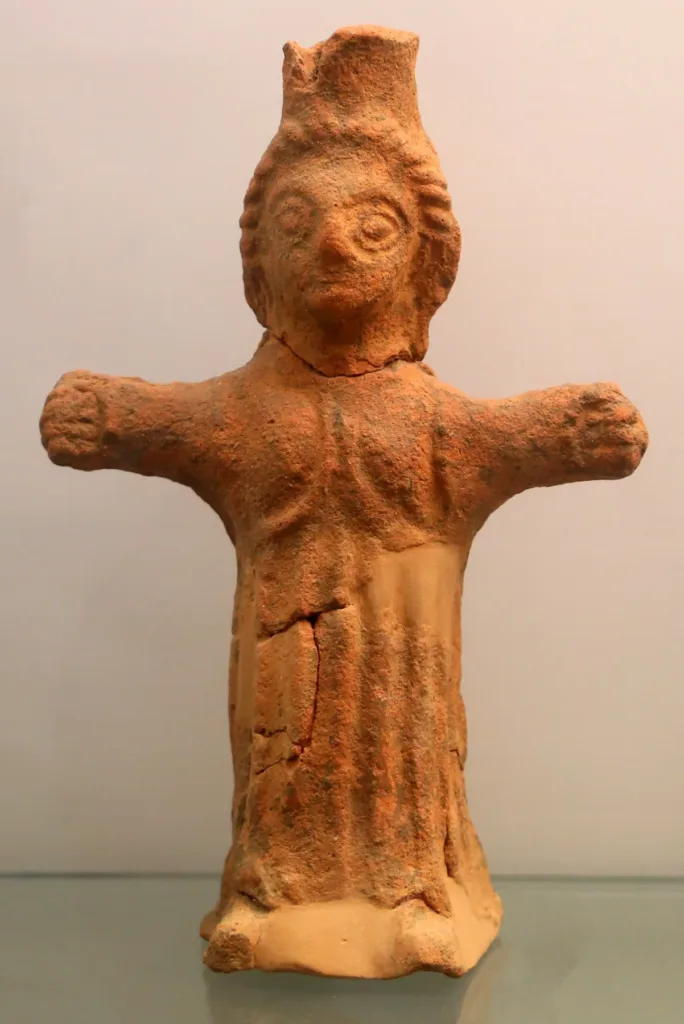
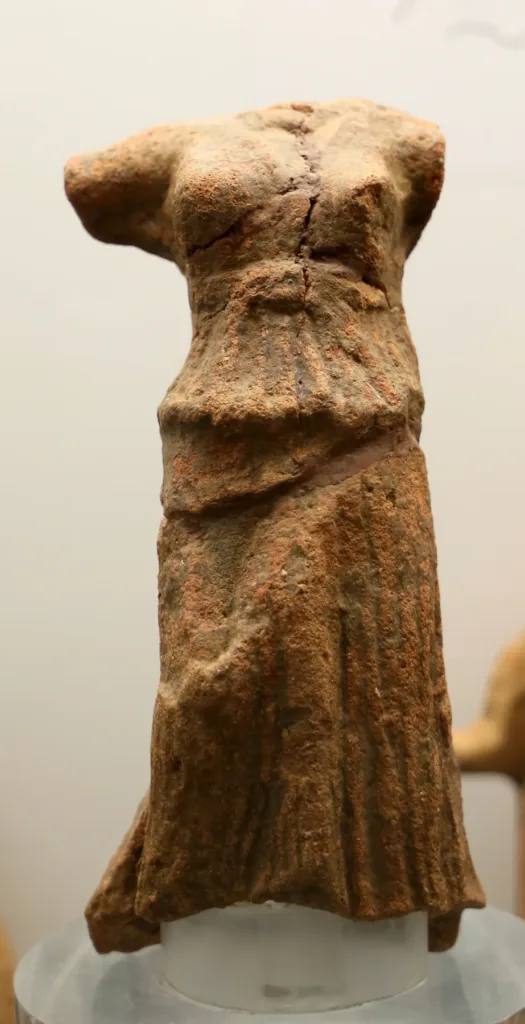
In the first object photograph, the figure retains its head, torso and extended arms. In the second, the body is incomplete and the drapery is more legible than the missing face. Comparing them shows how strongly preservation shapes our perception. An incomplete object is not necessarily less informative. It may draw attention to clothing or workmanship that a viewer overlooks in a more complete figure, where the expression of the face tends to become the immediate focus.
Sailko’s images are documented as photographs taken in 2019 at the Villa Sulcis Archaeological Museum in Carbonia, showing objects from the sanctuary at Narcao. The location of a photograph does not relocate the archaeological site to Carbonia. Likewise, a scholarly page published by Cagliari’s national museum does not establish that every object illustrated here is displayed in Cagliari. Our captions keep these references separate, because confusing them could easily lead to planning a visit to the wrong destination.

Connecting objects and places carefully
The Municipality of Carbonia provides contact details for Villa Sulcis Museum. If travelling to see a particular object, ask whether it is currently on display: an archive photograph cannot confirm today’s exhibition. For the sanctuary at Terraseo, check site access conditions with the Municipality of Narcao instead. These are two separate stops, and their practical arrangements need to be checked independently rather than inferred from the shared subject of the images.
Demeter’s temple becomes clearer when these distances remain visible: between findspot and museum, between Punic use and Roman attendance, and between a complete figure and a fragment. None prevents interpretation; each makes the questions more precise. The surviving offerings and remains on the ground cannot reconstruct an entire ceremony. They do, however, allow us to examine how a sacred space left material evidence that can still be recognised when its architecture has been reduced to relatively modest traces.