

In Iglesias, the church of Nostra Signora di Valverde invites you to follow three threads: the stone of its facade, the vaults inside, and a painting now kept elsewhere. The evidence for this building is not all gathered in one place. Understanding it involves connecting what survives on site with information preserved in studies and collections.
Valverde stands beside the monumental cemetery, in an area now incorporated into the town but originally outside its medieval walls. The church’s directory entry helps locate it on the map. This guide focuses on Valverde itself. For another religious landmark, consult the separate article about Santa Chiara Cathedral.
Following the facade upwards
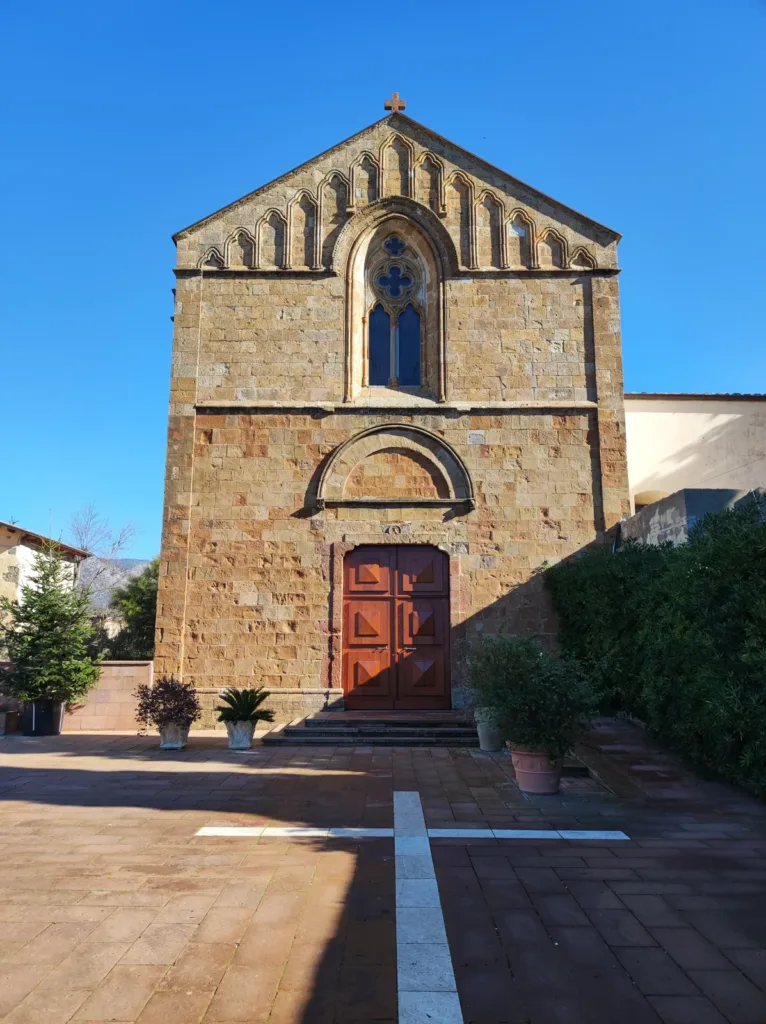
The frontal photograph reveals an axis running from the doorway through the window to the cross at the top. Horizontal cornices interrupt the upward movement, while the small arches in the upper section follow the roof’s two slopes. You do not need to know every architectural term immediately: this sequence already makes the facade’s composition intelligible.
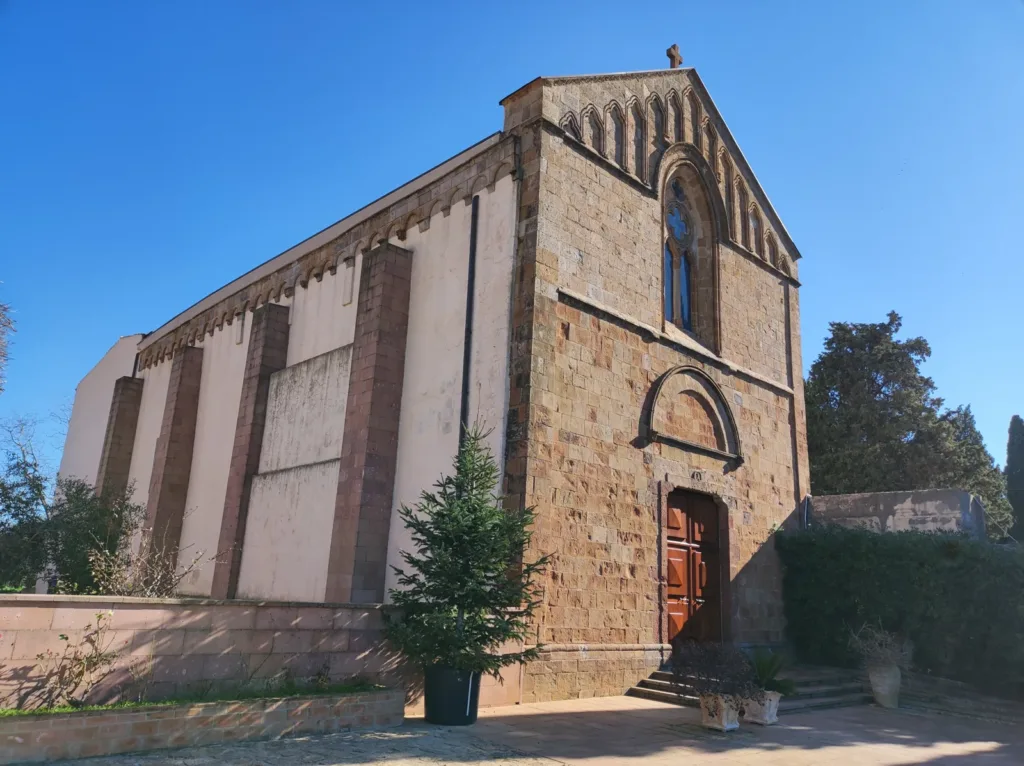

SardegnaCultura places the original building in the late thirteenth century on the evidence of its construction, noting the absence of direct documentation for its foundation. The volcanic-stone facade and parts of the side walls belong to the earlier core, while the interior underwent substantial changes. It therefore helps to distinguish a date inferred from architectural forms from dates physically recorded in later structures.
On the frontage, the arch above the door is rounded, while the opening higher up introduces a pointed outline. Its two lights are divided by a slender support. These details help explain why the church is described through the meeting of Romanesque and Gothic elements. The oblique photograph adds the side wall to the frontal view, showing how much of the building lies beyond its most decorated elevation.
The date 1592 recorded in the vault
Iglesias Turismo describes the sixteenth-century transformation of the single hall, divided by pointed arches supporting the timber roof, and the square sanctuary covered by a stellar vault. The bosses preserve a small carved record: the central one depicts the Virgin and Child; others carry the date 1592, the name of the obrer Antioco Spada and the monogram JHS, alongside the maker’s name.
The Italian term “gemma” here refers to an element of the vault, rather than a precious stone set in jewellery. The date and inscriptions give the roof documentary value beyond its decoration. The name of the person responsible for the building works also recalls the organisation, accountability and resources involved in transforming a church, alongside the craft skills required to cut and assemble its stonework.
A chapel with its own chronology
Not every interior covering should automatically be assigned to 1592. A study by Marco Rosario Nobile and Federico Maria Giammusso, available on the diocesan website, considers Valverde’s sophisticated side chapel within early sixteenth-century architectural experimentation. It discusses a proposed date close to 1520 as a research hypothesis. The chapel and the sanctuary therefore call for attention to their separate chronologies.

The architectural question concerns the transition from a square base to a more complex covering through niches and ribs. To follow the reasoning, identify the shape of the space at ground level, then look at how its corners change higher up. The same study notes a small oblique arch on the chapel’s left side. It is a specific feature to look for with a guide’s help, without assigning it an unproven function or symbolic meaning.
A predella now in Cagliari
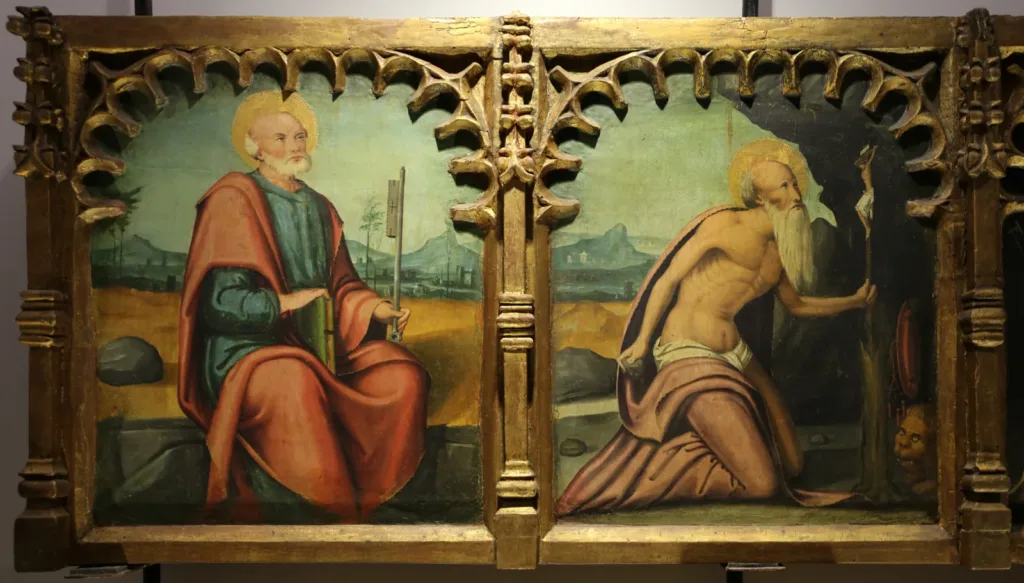
The ministry’s Idese entry records a predella from the church, attributed to Antioco Mainas and held at the National Picture Gallery in Cagliari. Its overall subject is the risen Christ among saints. The image reproduced within this article shows a detail with Saint Peter and Saint Jerome. It therefore documents part of a painting in a collection, rather than furnishing visitors should expect to find inside Valverde today.
A study by Maria Grazia Scano Naitza in ArcheoArte urges caution about the predella’s original location. Evidence for its presence at Valverde does not automatically settle the initial provenance of every part of the altarpiece. This distinction matters to visitors: a work can be historically associated with a church even when some stages of its earlier history remain unresolved.
Planning a visit around specific questions
Before entering, check access and services with the parish listed by the diocese. The church is a place of worship. A Mass timetable alone does not establish when visitors can spend time studying its art and architecture. If you want to see a particular work or examine a chapel, ask specifically so that you can plan an appropriate visit.
Three questions can accompany the route: which parts of the frontage belong to the medieval building, which covering preserves the date 1592, and where is the painting formerly kept in the church today? The answers lead from the facade to the interior and then into the history of collections. This distribution of evidence makes Valverde a rewarding stop without compressing all its transformations into a single period.