
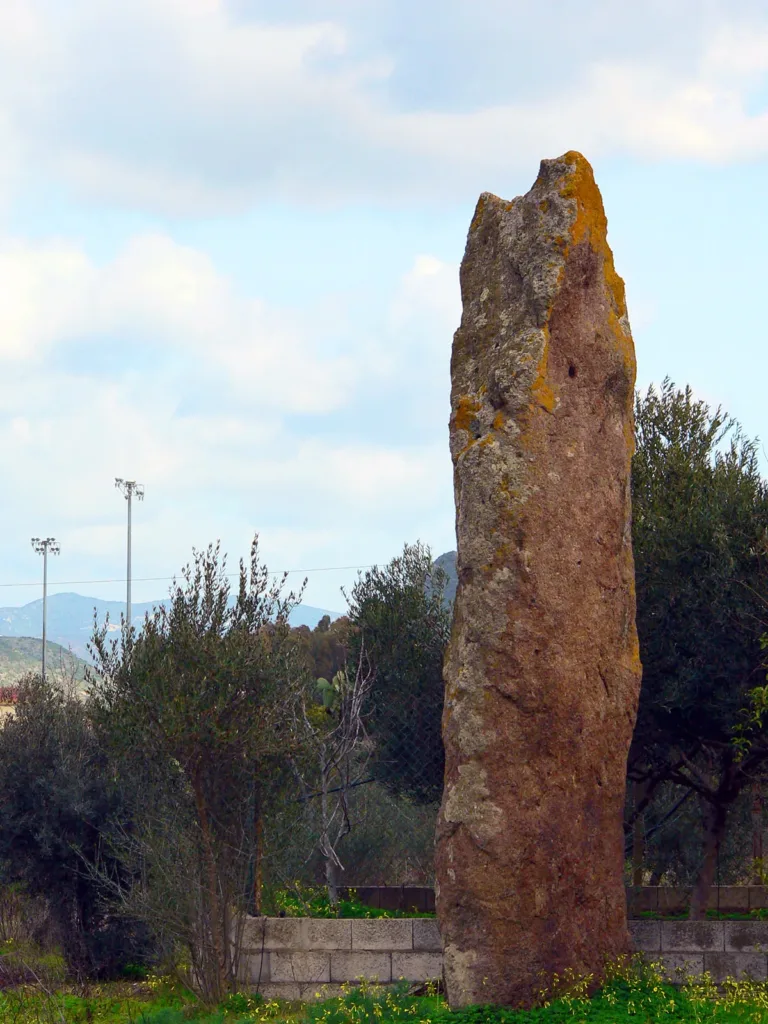

At Terrazzu, just south of Villaperuccio, a standing stone rises above the edge of a field. Known as Luxia Arrabiosa, it is one of the most recognisable landmarks of the area’s prehistory. Its visual impact also comes from the setting: fields and a road rather than a museum gallery. Understanding it means bringing together three perspectives without confusing them: the archaeological object, the landscape in which it appears today and the popular story that gave it such a memorable name.
Identifying the Terrazzu standing stone
The Ministry of Culture places the monument near the meeting of two watercourses and gives its height as more than five metres, despite the loss of its upper end, attributed to lightning. The regional description distinguishes this stone from the one at Monte Narcao. That distinction matters when comparing photographs and measurements: a page covering several menhirs does not allow every measurement mentioned for the group to be assigned automatically to Terrazzu.
The most useful geographical reference is Via Santa Lucia, linking Villaperuccio to the small settlement of Terrazzu. The stone stands in land adjoining the road. The Luxia Arrabiosa directory entry identifies its position. The name alone is insufficient when navigating Sardinia’s many stories and monuments associated with similar figures. Keep both the municipality and the locality in your search so that descriptions of a different place do not become part of the visit.
Two different faces of one stone
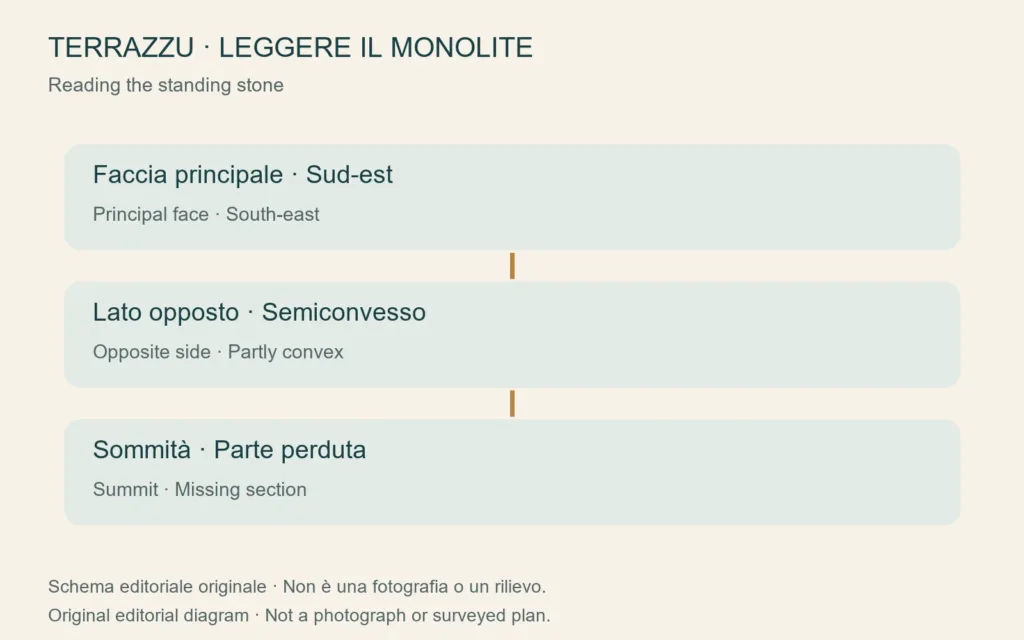
The documented principal face points south-east and is flatter than the opposite side. The corners are rounded, and the section is not a regular circle. This helps explain why the monolith can look different depending on the camera angle: frontal and oblique photographs emphasise different proportions. Images that appear to show different widths do not necessarily record changes to the stone; they may simply reveal different aspects of its three-dimensional form.
The terminology used to classify it deserves clarification. SardegnaCultura places the area’s standing stones within an aniconic type, without recognisable depictions of people. Idese notes that Terrazzu’s flattened front and partly convex back approach a proto-anthropomorphic scheme. These descriptions emphasise different criteria: the absence of figurative details and a possible tendency towards a human-like outline. They do not mean that visitors should expect to find a carved face or an identifiable portrait on the surface.
Chronology and the limits of observation
Idese suggests the fourth–third millennium BC, while the regional account places the phenomenon between the Neolithic and Copper Age. These are prehistoric periods, long before the emergence of the modern village. A standing stone does not necessarily carry an inscription naming its maker or recording a date. Its chronology relies on archaeological comparison. A broad period is therefore more responsible than presenting a specific year as though it were securely known.
The regional account interprets menhirs in relation to the fertility of the land. This is a cultural interpretation, not a record of a particular ceremony documented at this stone. These sources do not tell us the words spoken, the gestures performed or the identities of participants. Acknowledging those limits does not reduce the monument’s value. The monolith is material evidence; explaining the meaning once attached to it requires a separate argument.
Luxia, anger and petrification
The name is translated as furious Lucia. The Ministry refers to stories in which a woman or giantess, angry at a wrong suffered, throws an object that becomes embedded in the ground and turns to stone. This is a narrative explanation for an exceptional feature in the landscape. It is neither a verified memory of the prehistoric transportation of the monolith nor proof that every tale involving Luxia arose from one original event.
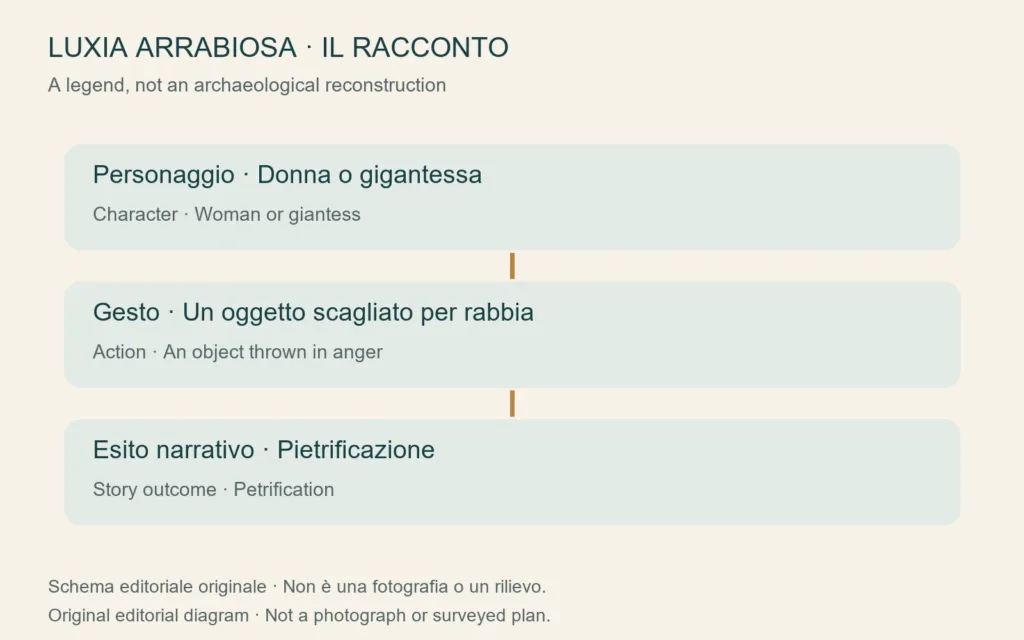
The legend diagram included in this article consequently separates three components: the character, the action and petrification. It is an editorial representation of a story, not a documentary illustration of real events. Placed alongside the photograph, it helps distinguish two kinds of evidence: the stone that can be observed and the tradition through which people explained it. Each can contribute to understanding the place, provided neither is allowed to stand in for the other.
Observing the monument respectfully
Idese describes the stone as visible from outside. Being able to see it from the road does not imply permission to enter the field or cross any boundary. Before stopping, identify somewhere lawful and safe that does not obstruct movement. A view from a little distance can already reveal the relationship between the stone’s height, the ground and nearby buildings. An extremely close photograph would remove much of that setting from view.
Villaperuccio preserves other prehistoric remains, but this stop rewards attention to the individual monolith. Begin with its overall position, then consider the orientation of its face and finally distinguish the surviving form from the lost summit. This simple sequence does not require touching or climbing the monument. It produces a more precise understanding of Terrazzu than treating it only as a striking image of a large and mysterious stone in the countryside.