
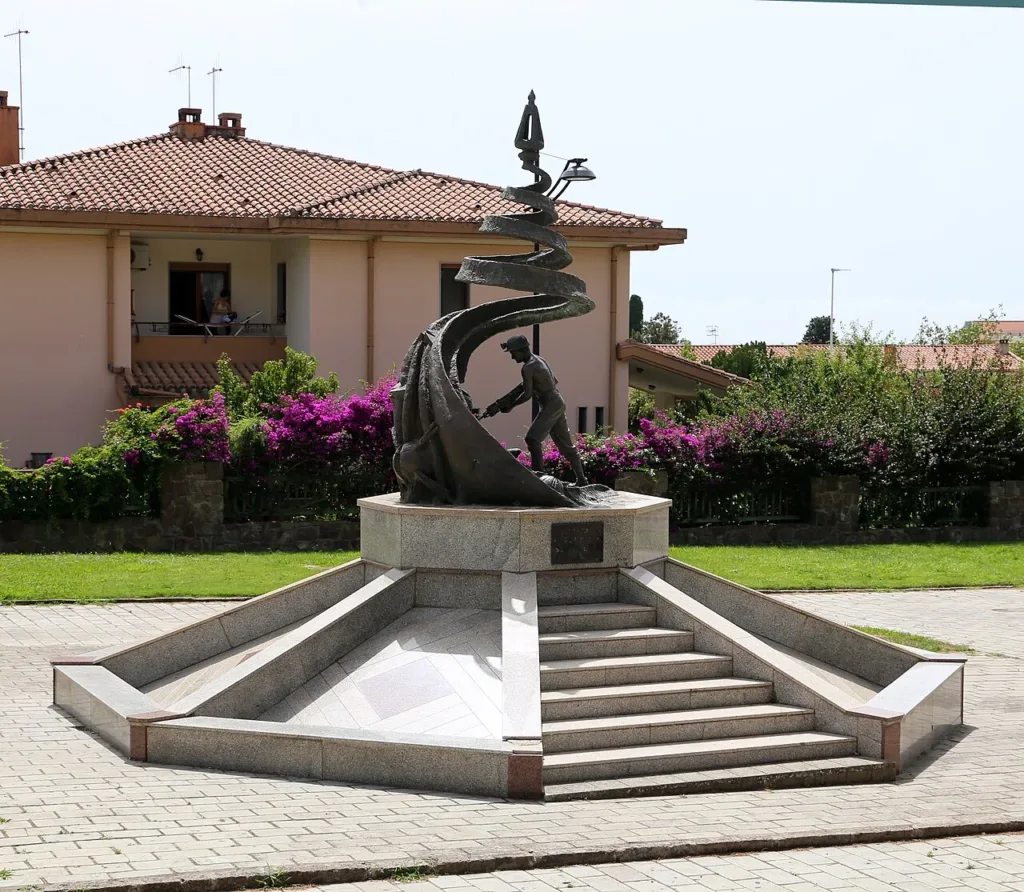

In central Carbonia, the Miners' Monument brings the memory of work out of industrial buildings and into the town's everyday public space. The sculpture rises above a stepped base, developing vertically and changing its appearance with the observer's position. There is no need to enter a mine to encounter this dedication. Remembrance takes the form of a public artwork, visible among paths and gardens within the inhabited town.
Use the Piazza Roma directory marker for orientation: it identifies the nearby square, rather than the sculpture's exact position. The monument stands in the gardens between Piazza Roma and Via Roma. Search specifically within Carbonia, since other mining towns also have monuments dedicated to miners. Similar titles do not necessarily refer to the same place, the same work or the same sculptor.
A dedication for the fiftieth anniversary
A 2017 ANSA report describing a municipal cleaning intervention attributes the work to Giuseppe Vasari and dates its installation to 18 December 1988, Carbonia's fiftieth anniversary. That date helps explain the monument's position in the town's history. It is a later act of commemoration, through which Carbonia looked back at its origins and chose to give mining labour a clearly recognisable place within the public representation of the community.

The May 1988 issue of a periodical preserved by Sardegna Digital Library documents that year's celebrations and discusses the monument while it was still being prepared. Reading a contemporary account alongside the later report distinguishes the proposed work from its eventual installation. An anniversary involves more than a date on an inscription. Decisions, ceremonies and ways of describing the town can all leave documentary traces beyond the completed sculpture itself.
A shape seen from more than one side
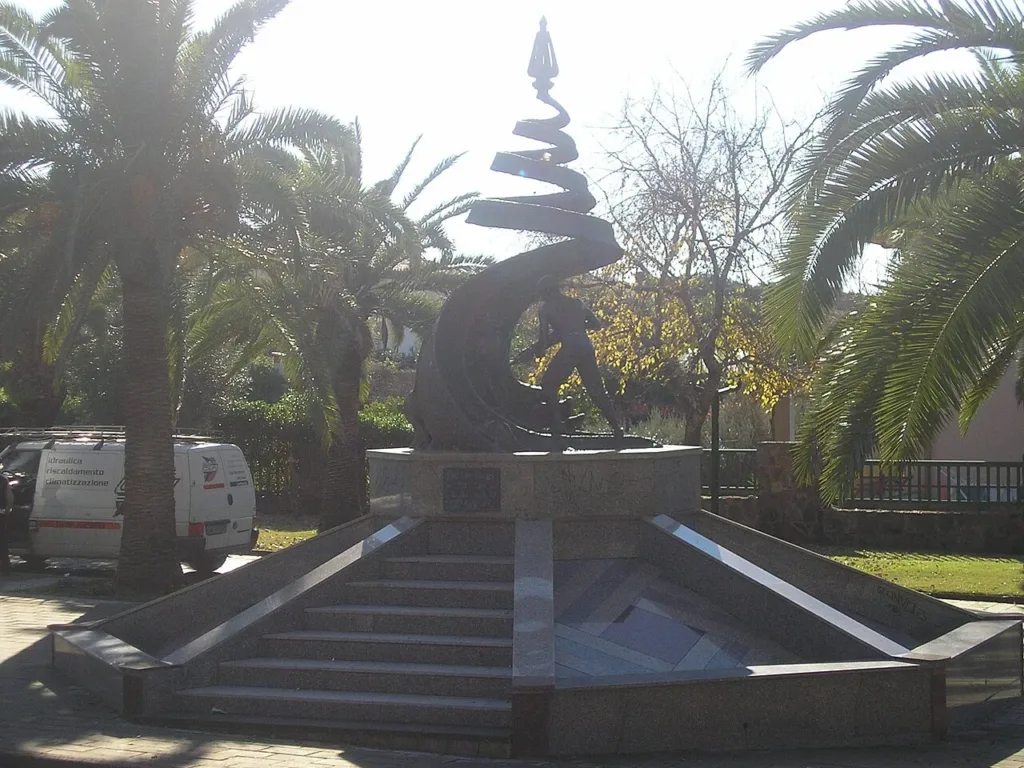
In the 2019 photograph, the upper part develops through a winding movement, with solid sections and openings allowing the background to show through. Light separates some outlines while others overlap. The 2006 photograph presents the same work from another viewpoint, with palms and vegetation behind its silhouette. Comparing them demonstrates that a sculpture cannot be reduced to one frontal image: its surroundings contribute to the way its form is perceived.
The base establishes a second movement, drawing the eye upwards from the steps towards the centre. Sloping surfaces and pale edges create a wider figure at ground level, while the artwork narrows as it rises. These are observations supported by the photographs, rather than an official explanation of the artist's intended symbolism. Assigning a precise meaning to every individual element would require statements by the sculptor or documentation associated with the original commission.
Looking alongside faces photographed in 1950
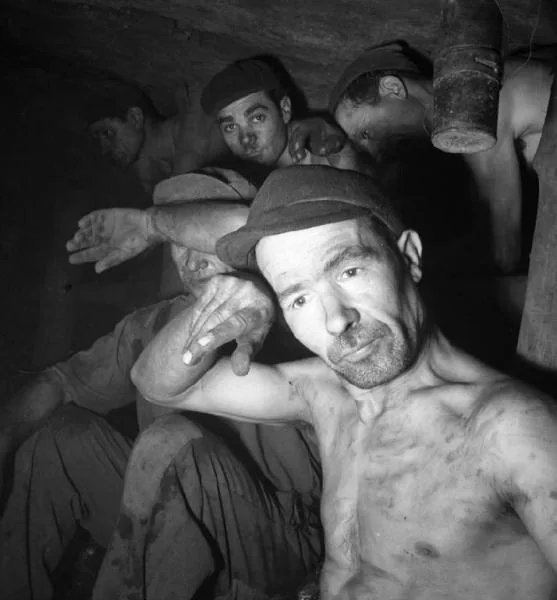
The two sculpture images are accompanied by a different kind of document: a group portrait made in Carbonia by Federico Patellani in 1950. The Lombardia Beni Culturali catalogue identifies the subjects as miners in a coal mine and connects the photograph with the Patellani collection at the Museum of Contemporary Photography. Its classification as reportage and its date provide context without inventing names or personal histories for the people shown.
A face, a hand beside the head and an illuminated torso emerge in the foreground; other men occupy the dark, closely framed space behind. The difference from the monument is specific. The photograph preserves bodies and expressions present before the camera at one particular moment, while the sculpture creates a collective dedication. There is no reason to assume that they represent the same individuals, or to turn a photographed posture into personal testimony that was never recorded.

Caring for remembrance in public space
The 2017 report records cleaning following defacement. That episode reveals a practical aspect of public remembrance that is easily overlooked: an exposed artwork needs care after its inaugural ceremony is over. The report documents that intervention, rather than its current conservation condition. The sculpture photographs likewise belong to their stated dates and should not be mistaken for an up-to-date inspection of maintenance, surface condition or the arrangements around the monument.
A pause here can follow three steps: identify the dedication and its period, observe how the outline changes while moving within public space, and compare the collective representation with the photographic document. The subject remains the memory of miners, rather than a technical account of coal extraction. The Carbonia blog collection offers other perspectives on the town. Here, the question is how work becomes a shared image and a lasting presence in the streets.