
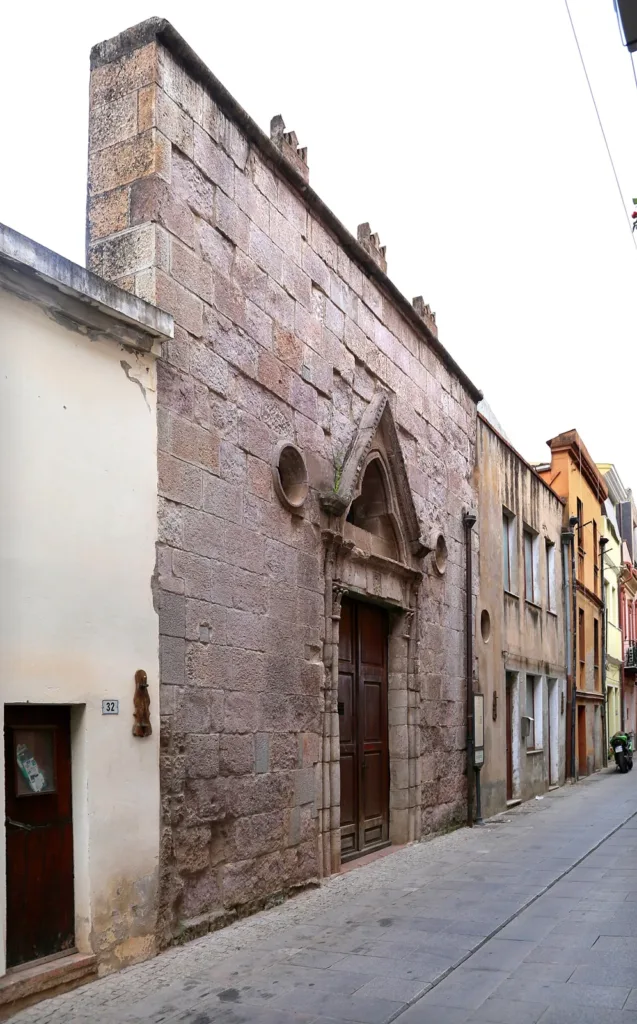

San Domenico church stands on Via Felice Cavallotti in Iglesias, within a continuous street of houses in the historic centre. The façade photograph makes this setting clear. Stonework, the entrance and the outline at the top distinguish the religious building, while neighbouring homes continue on either side. It does not need a broad square to announce itself: much of its visual identity is concentrated around the doorway.
The San Domenico directory entry provides its location on the map. On approaching on foot, look first at the street as a whole, then move your attention towards the entrance. Changing the viewing distance helps reveal both the church's place within the residential setting and details that can disappear into the texture of the masonry in a wider view.
A doorway that draws the eye
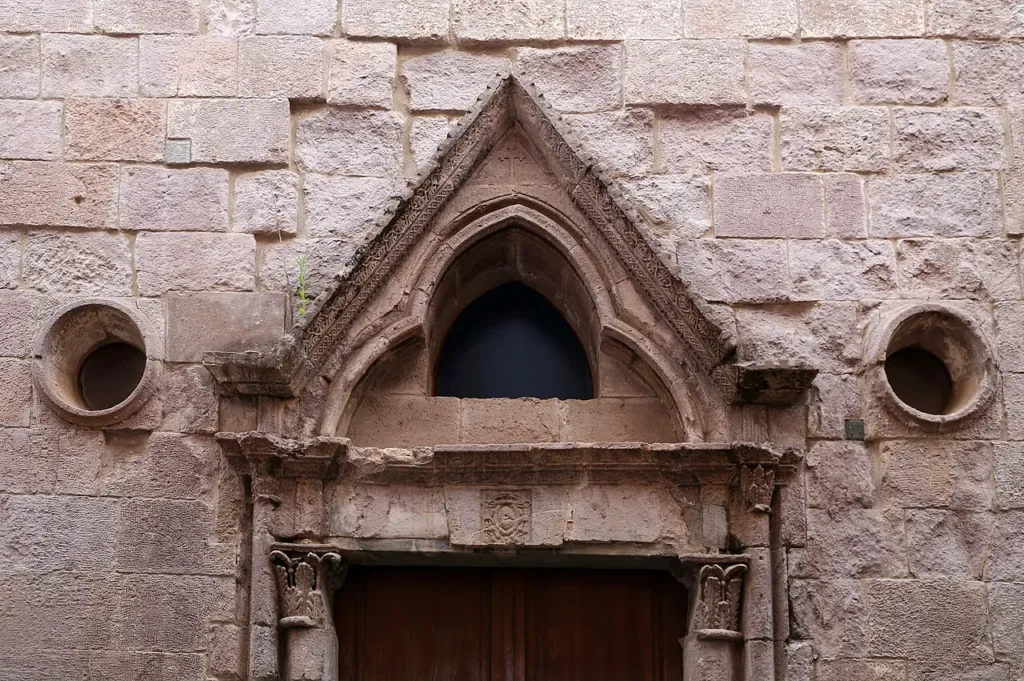
In the closer photographs, vertical elements and a horizontal frame surround the entrance. Above them rises an arch with an intricate outline and a dark opening at its centre. Two small circular features flank this upper composition. The contrast between straight and curved lines is an accessible starting point: it can be appreciated before identifying the technical name of each individual architectural element.
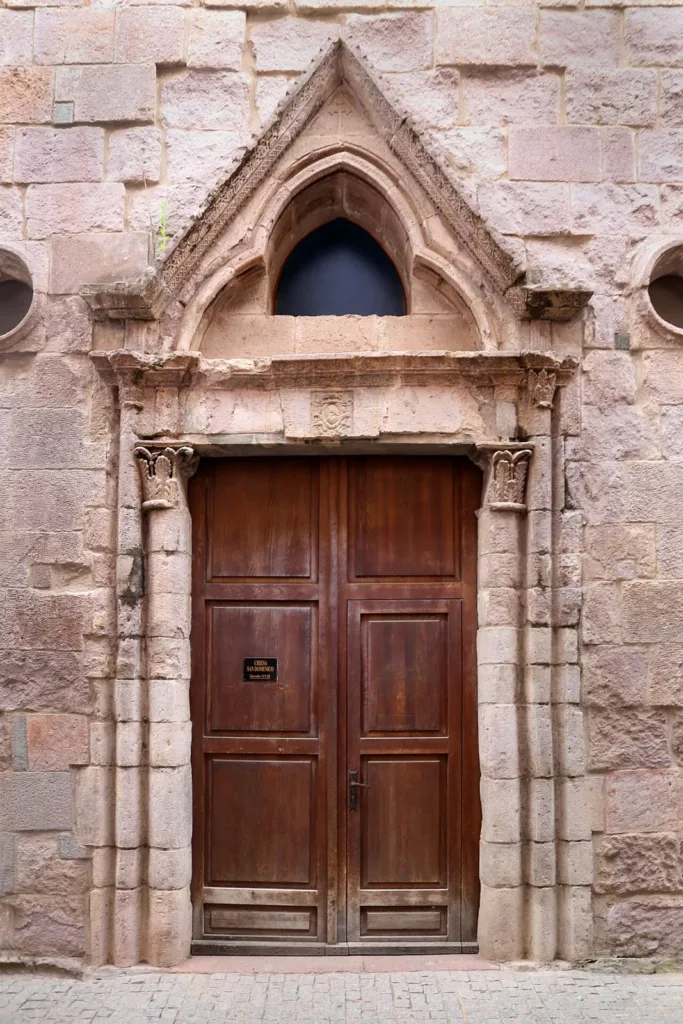

The tightest view separates projecting surfaces, joints and mouldings that are harder to distinguish in the complete façade. Photographs, however, cannot reproduce depth, colour and light under every condition. The three images shown here were taken in June 2019. They document different views of the same building, not successive changes to it, and should not be mistaken for a survey of its current condition.
Patronage and the story of the children
Iglesias Turismo places the church's construction in the early seventeenth century and highlights the patronage of Bishop Nicolò Canavera. It also records a bequest made to the Dominicans in 1610. These references help place the building in time. Forms recalling Gothic architecture are not, by themselves, enough to establish that the whole structure belongs to the medieval period.
A local tradition gives it another name, Cresia de is picciocheddus, or the children's church. According to the legend recorded in the regional guide, children helped carry materials during construction. This should be understood as a traditional story, separate from documented dates. The nickname adds a layer of community memory without proving how labour was actually organised on the building site.
Memorials moved from floor to wall
The city's tourism guide describes funerary slabs formerly incorporated in the floor and now displayed on the walls. Moving them changes the way they are encountered. A surface once passed over underfoot becomes something examined face-on. The physical object still carries historical information, but its relationship to the surrounding space is no longer the original one.
If the interior is open, distinguish between an object and its present position. A date carved into a memorial does not date the wall behind it. Recognising a portrait is not enough to identify its subject without a reliable label or guide. Such distinctions prevent every feature from being assigned to the same phase and make the history of a repeatedly altered church more understandable.

The sanctuary that made way for a street
The most substantial loss concerned the church's far end. Iglesias Turismo records the demolition of the sanctuary to create the road behind the building, Via Eleonora. Its arch was closed and incorporated into the new end wall. The relationship between church and city is therefore more than a matter of street frontage: a road intervention physically reduced the depth of the religious space.
Remembering this missing section helps avoid treating the current arrangement as an unchanged original design. It is possible to recognise that a space has been lost without inventing its dimensions or furnishings. Check access through the city tourism website before planning an interior visit. For a separate building, the article on La Purissima provides another architectural story. At San Domenico, the central theme remains the relationship between a small church, its visible signs and changes to the streets around it.