
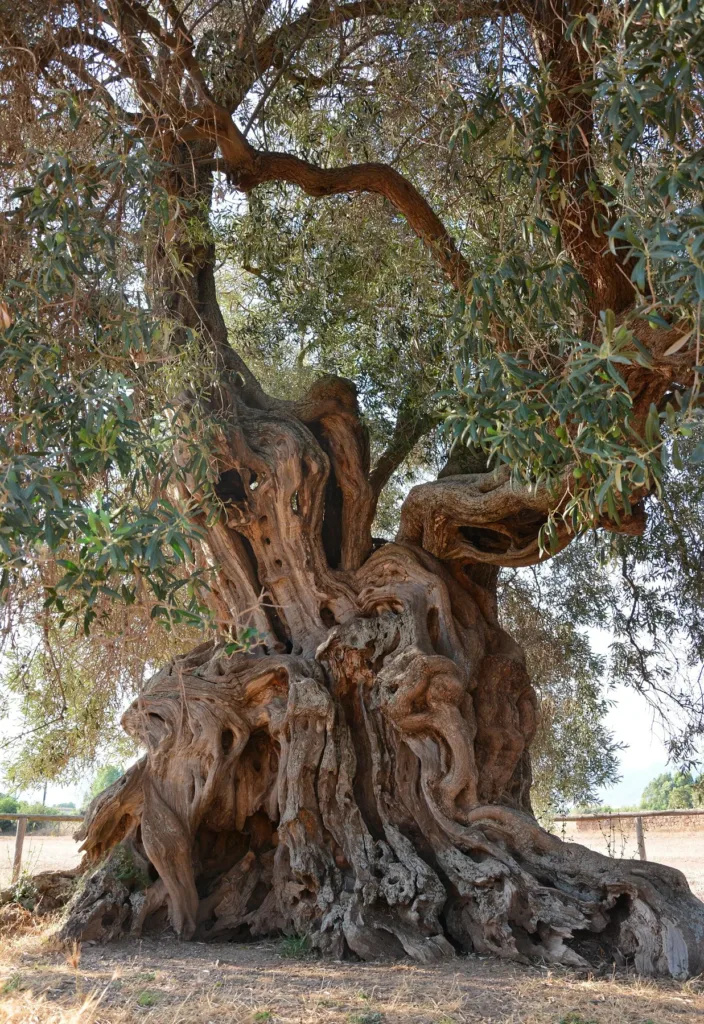

The name Sa Reina encourages visitors to look for a single tree, but S'Ortu Mannu also makes sense through its surroundings. In the countryside of Villamassargia, olive trees create a landscape of canopies, gaps and trunks that resist any simple geometric description. The best-known tree is a landmark within that larger setting. Pausing to examine its base and then widening the view turns curiosity about one specimen into an encounter with an entire olive grove.
Our Sa Reina directory page marks the location on the map. The municipality places S'Ortu Mannu about four kilometres from the town, along the road running below the hills towards Cagliari. There is no need to imagine an isolated wilderness: its connection with Villamassargia is part of its meaning. This is an inhabited, tended countryside in which the presence of trees is interwoven with the lives of people.
The queen and the size of its trunk
The municipal description gives Sa Reina a circumference of sixteen metres at the base. Circumference is not diameter; confusing the two creates a radically different picture of the tree. The 2018 photograph shows an elaborate base with folds, hollows and branching forms that make its departure from a regular cylinder obvious. The measurement helps convey scale, while the image reveals a complexity that a number cannot communicate on its own.
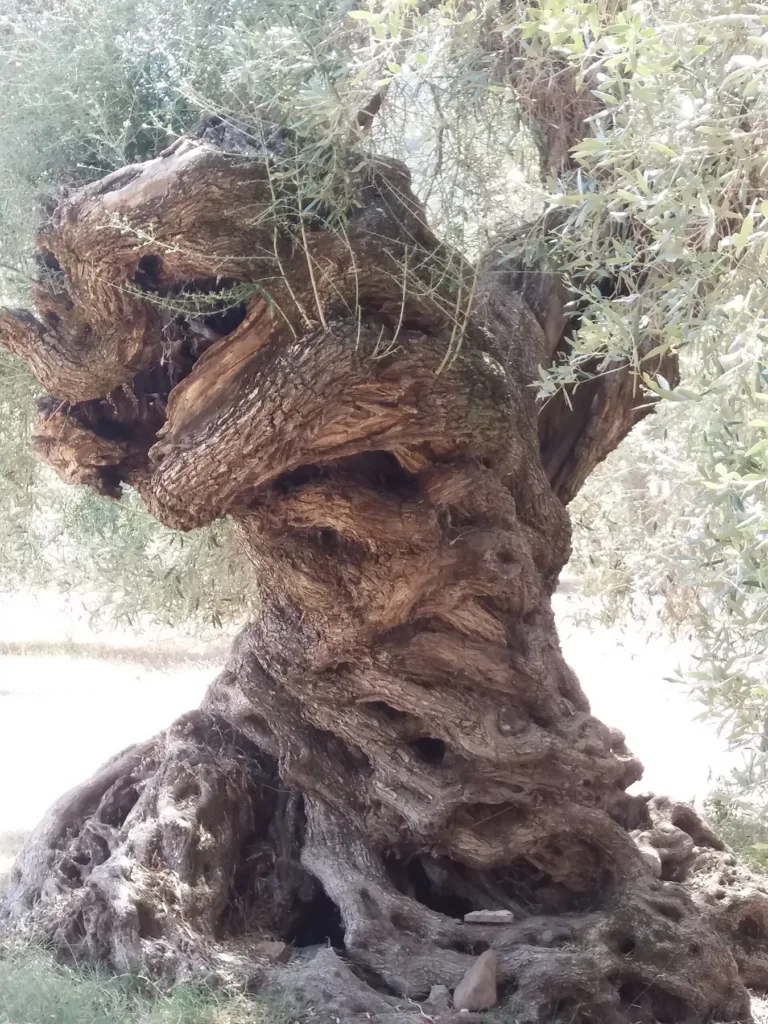

A precise birth date is not necessary to appreciate Sa Reina. An ancient-looking trunk is not a calendar that can be read by eye, and age estimates depend on methods and margins of uncertainty. A more productive question during a visit concerns what is actually visible: which parts of the tree can be distinguished, how is the canopy distributed, and how does its outline change along the path? Time becomes something to investigate rather than a striking figure to repeat.
A monument encompassing a grove
The regional inventory of natural monuments records S'Ortu Mannu as a historic olive grove, with its designation dating to 2008. That wording places an ensemble at the centre of attention and discourages a reading limited to the famous tree. Less-photographed specimens also contribute to the character of the place. The intervals between trunks, the separation or overlap of canopies and the open ground create a recognisable landscape, rather than a display containing one exceptional object.
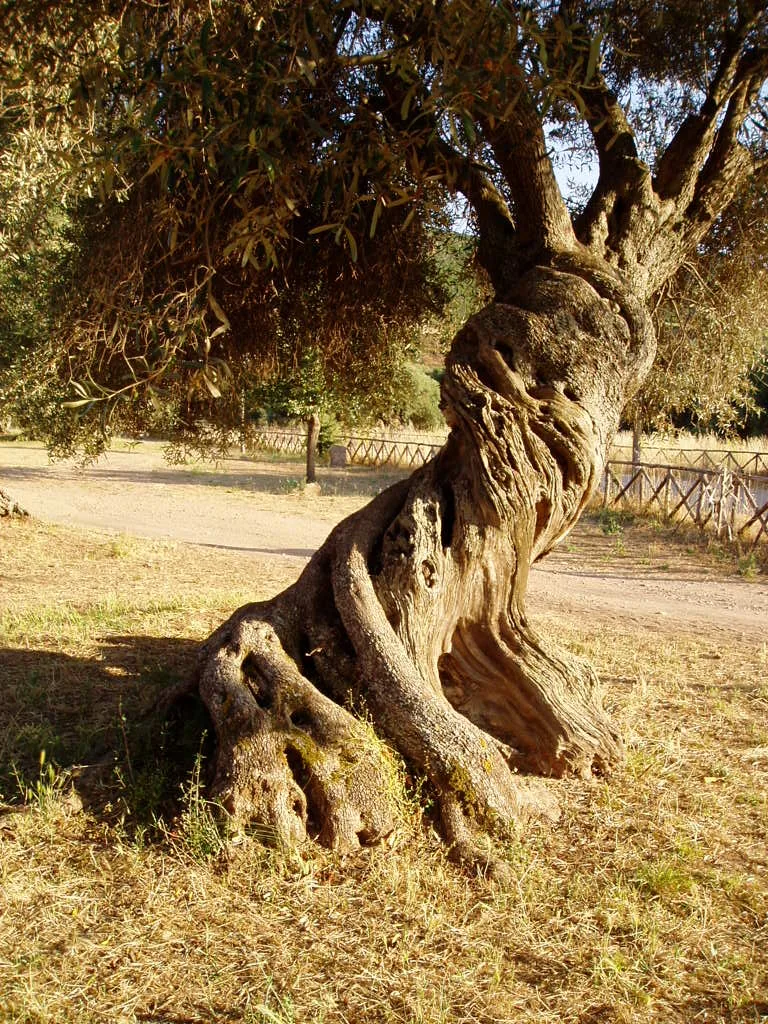
The two photographs within the article provide useful comparisons. The 2019 image moves close to the twisting trunk, while the 2004 view includes more of the surroundings. They are not interchangeable: one emphasises surface and the other the relationship with the ground. The same method can be used on a walk. From a respectful distance, examine a particular form and then its position within the grove, without climbing onto roots or branches to improve the viewpoint.
Trees, families and landscape continuity
A University of Sassari study presented at ASITA in 2016 describes a historical feature of management here: the distinction between rights over the land and rights over individual trees. This reminds us that an olive grove is more than a botanical collection. Responsibilities, customary arrangements and family relationships may gather around a tree. That historical information should not be used to assign a particular specimen to a present-day owner without verification, but it explains the community's importance to the story.
The same research compares aerial photographs from different periods to investigate the grove's persistence and changes in neighbouring land. This perspective complements the experience of walking beneath the canopies. From below, individual trunks dominate attention; from above, arrangement and continuity become clearer. The two readings are compatible. Together they suggest that caring for a landscape involves both its recognisable elements and the relationships between them, rather than focusing exclusively on a single celebrated specimen.

Visiting S'Ortu Mannu
The municipal page about the natural monument lists free access. Check for any notices before travelling and respect boundaries on site. Permission to enter does not imply permission to collect fruit, cut branches or use the trees as climbing structures. If you have particular access needs, ask about path surfaces and the areas that can be reached. Apparently level ground alone does not establish the accessibility of the complete visit.
An attentive visit might begin with Sa Reina and finish beside another olive tree chosen simply because a particular shape catches the eye. That comparison restores the queen to its setting and gives the other trees their individuality. S'Ortu Mannu remains a tangible part of Villamassargia's countryside: a living ensemble shaped by growth and care. It invites precise observation rather than a search only for the largest measurement or the most astonishing claim about age.