
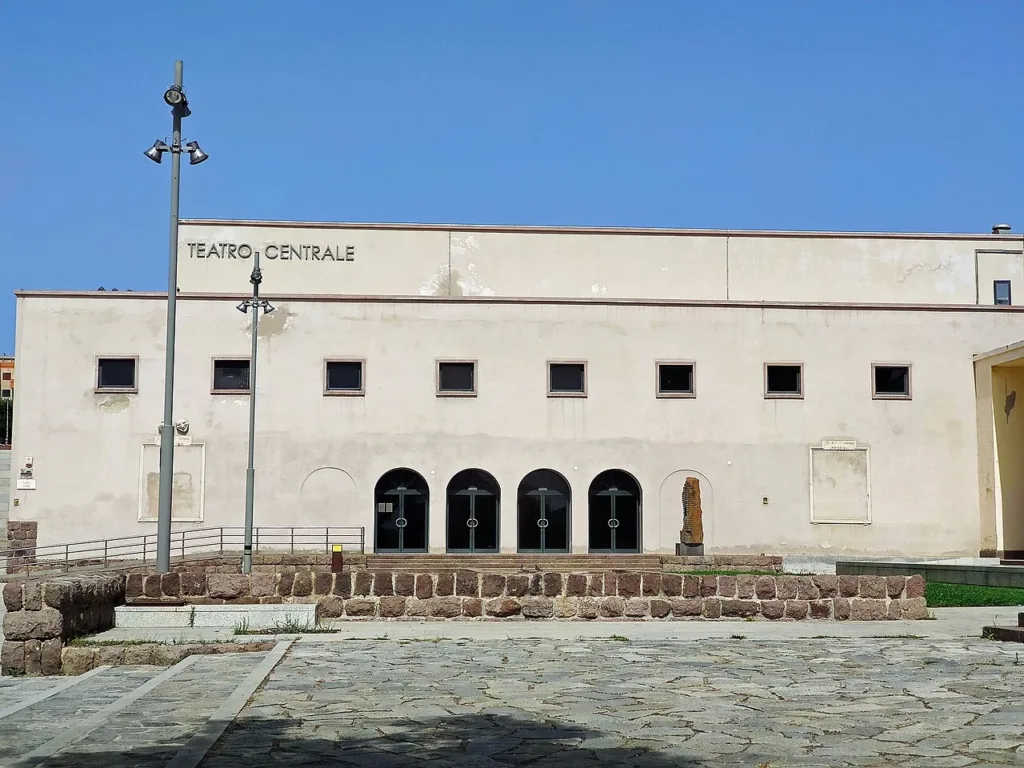

Two masks, one tragic and one comic, announce the purpose of Carbonia's Teatro Centrale before a visitor reads a programme. They sit above a framed area intended for posters, turning a small piece of carved decoration into a statement about performance. Higher up, the theatre's name identifies the building, while a sequence of arched entrances draws attention towards the threshold. These signs address both people searching for the venue and those simply passing by.
The Teatro Centrale stands in Piazza Roma. Its directory entry on the map helps distinguish it from other cultural spaces in Carbonia. This article concerns the venue as a place for cinema, performance and cultural participation. The wider arrangement of neighbouring public buildings is explored separately in the guide to Piazza Roma.
A rapid construction programme in a new town
The municipal description records work beginning on 8 November 1937, completion on 20 November 1938 and regular activity starting on 1 January 1939. Its historical designation as a cinema-theatre explains the dual purpose. This was not simply a hall for spoken drama: accommodating projected images as well as performances on a stage belongs to the building's original identity.

In its material for Monumenti Aperti, the municipality describes a hall designed for roughly four hundred people. That is a historical design figure, not confirmation of its currently authorised capacity. It nevertheless suggests the collective scale of the experience: a substantial audience sharing time, attention and reactions in front of a screen or a live performance. Such a setting is part of the cultural infrastructure of a town, alongside the production of individual shows.
Frames intended to communicate a programme
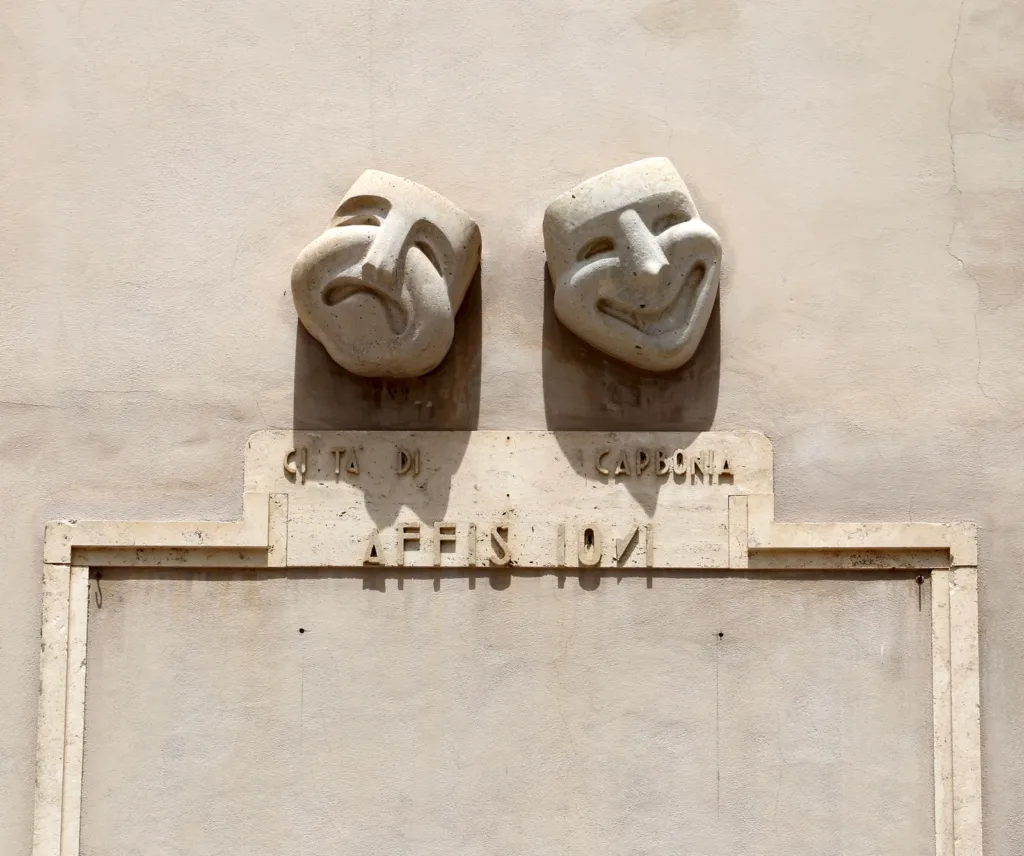
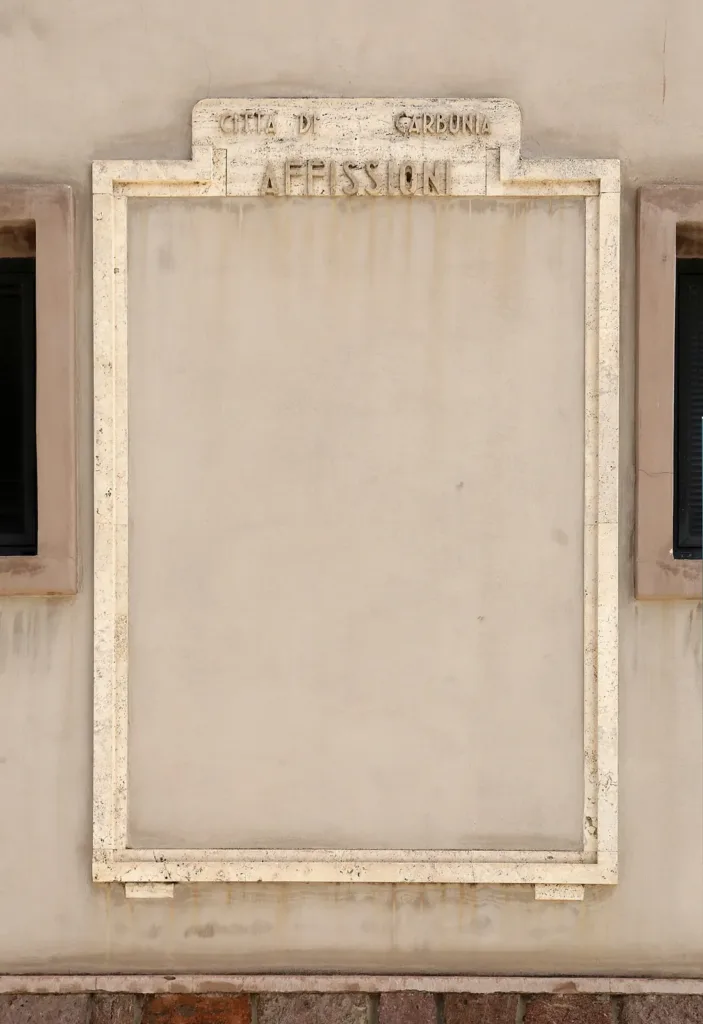
The detail photographed in 2019 shows the pair of masks above a rectangular frame. Their contrasting expressions make a theatrical symbol recognisable even without an accompanying poster. The other close view records a display area bearing the word “affissioni”, referring to notices or posters. These features show that communicating events was anticipated in the building's design, rather than depending entirely on temporary signs placed outside it.
An empty frame does not tell us what is being performed. It identifies a space where that information can appear. The detail photographs date from June 2019, while the wider view was taken in 2020. They document the exterior at those moments. Today's programme requires an up-to-date notice from the event organiser, including the full date and confirmation that this is the intended venue.
One venue serving different audiences
The municipality's theatre page describes activities ranging from plays and concerts to school matinées and events involving local associations. This variety matters as much as a list of individual companies. A regular theatregoer may encounter the venue through a season programme, while a young person first enters it on a school visit. The building remains the same, but the expectations and reasons for attending can differ substantially.
When choosing an event, start with the experience you want. For a play, language and duration may influence the decision. For a concert, check the performers and the programme. An educational event may have restricted admission. Appearing in a cultural calendar does not mean every appointment has the same entry arrangements. Checking the intended audience, booking requirements and door-opening time makes planning more reliable.

Attending an event and organising one
The municipal theatre-use service concerns permission to use the venue. People wishing to stage an initiative follow the Culture Office's procedure, whereas ticket holders need the arrangements supplied by the organiser of their particular event. These are different requests even when they concern the same building, so identifying the appropriate contact saves unnecessary confusion.
Before travelling, confirm any requirements concerning access, seating or assistance for the chosen performance. Allow enough time to find the entrance and read the notices without rushing. Looking again at the masks on the way inside gives the architectural detail a practical meaning. They mark a building whose cultural history continues whenever people gather there to watch and listen together, rather than existing only as a façade to be photographed.