
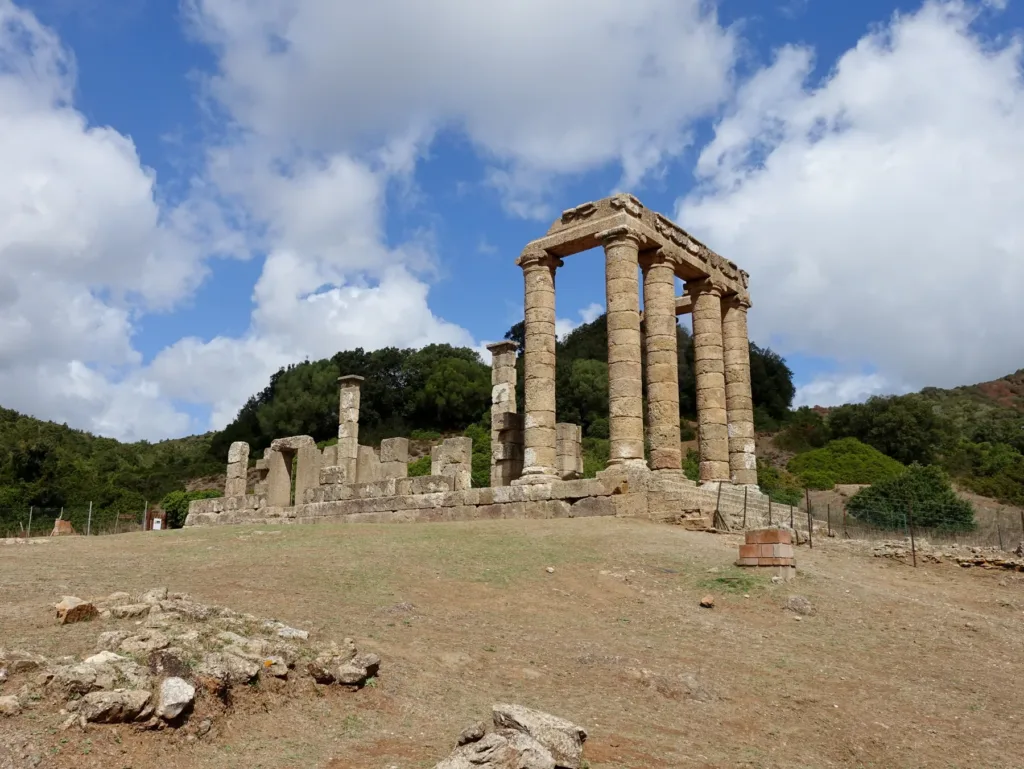

The columns at Antas often appear in photographs as an isolated building against a green backdrop. Look more closely and the temple continues beyond its frontage, through the podium, low walls and spaces left open by missing sections. This contrast makes the site rewarding to examine. The upright columns catch the eye immediately, while traces on the ground invite visitors to reconstruct a sequence of rooms and changes in their minds.
The monument stands within the municipality of Fluminimaggiore. Our Temple of Antas directory page locates it on the portal map. This article focuses on the sanctuary itself. The valley contains other remains, but treating all of them as one continuous story would obscure what can actually be observed in front of the columns. Before taking any additional trails, allow time for the central monument and its inscription.
A dedication that changes the interpretation
The Latin inscription on the architrave connects the building with Sardus Pater Babi and a restoration during the reign of Caracalla. It does more than provide an emperor's name. Its reference to a structure already damaged by age establishes that the monument had an earlier history. The practical implication is clear: the most recognisable Roman phase should not be treated as the very beginning of the sacred place, nor should every stone automatically be assigned to one intervention.

Reading the text was itself an achievement of research. SardegnaCultura recounts how a fragment identified by the scholar Caboni, together with another inscribed block recovered in 1967, enabled Giovanna Sotgiu to complete the inscription. A small piece can therefore change the identification of an entire complex. When looking at the inscribed band, consider the physical breaks as well as the letters: the ancient message reaches us through surviving fragments, comparison and reassembly.
Columns, thresholds and rooms
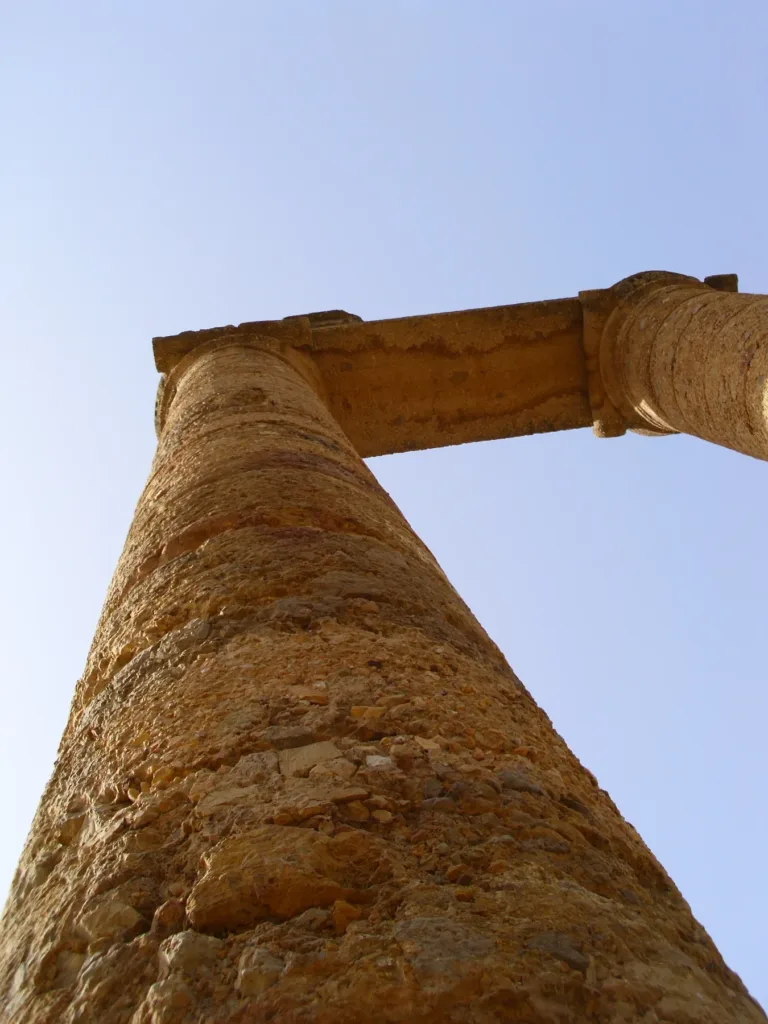
The frontage has four columns. In the close photograph, the shaft seen from below leads the eye towards the capital and the beam above it. At this scale, monumental proportions become a relationship between individual parts: the weight of the support, the transition at its top and the horizontal line joining the columns. This is an accessible way to begin looking, even without prior knowledge of the terminology used in classical architecture.
The operator's account distinguishes the pronaos, the cella and two rear compartments. These terms help explain a plan; they are not an invitation to walk through every surviving doorway. Visitors must follow the route indicated on site. Comparing the open frontage with the remaining walls is enough to begin recognising the sequence of spaces. The building once had depth and a roof, elements that its present open-air appearance can easily make us forget.
A sanctuary with several timelines
The regional archaeological description records Early Iron Age burials and Punic phases before the Roman temple. Relationships between the different deities and religious traditions therefore require care. The names Babai, Sid and Sardus Pater belong to a history of continuity and reinterpretation. Treating them as three perfectly interchangeable labels would remove the historical process that makes Antas distinctive. The earlier evidence is also less immediately prominent than the standing columns, so it benefits from explanation.
Some internal features remain open to debate. For the basins, the operator discusses different interpretations, including possible changes after the building's use as a temple. Keeping that uncertainty is more accurate than describing a ceremony as though it had been witnessed. A useful question for a guide concerns the evidence behind each interpretation: its position, materials, relationship with surrounding walls or comparison with other sites. This approach separates the surviving object from the explanation proposed for it.

Planning a stop at Antas
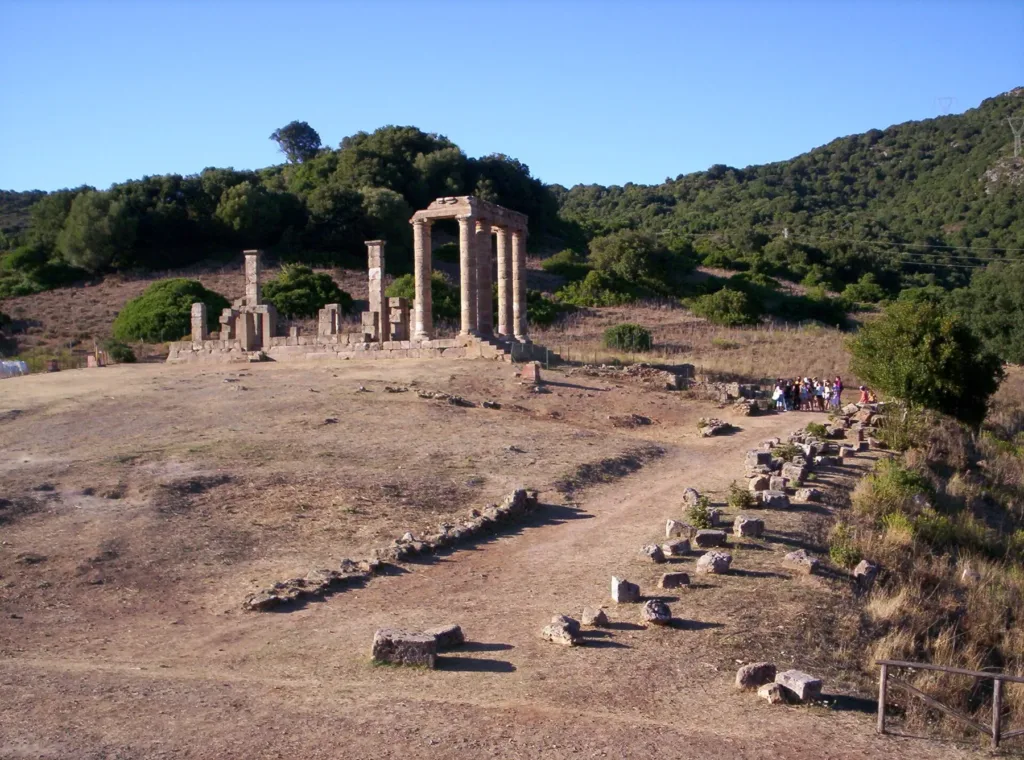
Check Start-Uno's visitor information for opening arrangements, tickets and services on your chosen day. A seasonal timetable should not be assumed to apply throughout the year. If you need assistance or particular access conditions, ask which sections of the route are suitable. Reaching the ticket office and moving around the entire archaeological area are different practical requirements. The photographs reproduced here were taken in different years and do not certify the current layout of visitor paths.
Alternate a broad view with time spent on a detail. The 2006 photograph conveys the amount of space surrounding the frontage, while the close image makes the texture of the stone easier to appreciate. The same comparison can structure a visit without chasing a single photographic viewpoint. Antas becomes clearer when inscription, architectural form and ground plan are considered together. They offer three ways to question a monument that provides specific answers while retaining important areas of uncertainty.