

Bacu Abis tells a coal-mining story that began before Carbonia was founded. It is now part of that municipality, yet the village’s mining past reaches back into the nineteenth century. That earlier history changes the perspective: Bacu Abis is more than a consequence of the new town inaugurated in 1938. It is one of the places where the coalfield’s work, investment and economic difficulties had already taken shape.
Understanding the village means considering production alongside everyday life. The shaft recalls underground labour; housing, communal spaces and celebrations tell the story of a community. The Castoldi shaft directory entry provides a starting point on the map. The museum visit at Serbariu is a separate experience, covered in the guide to the Coal Museum.
A history of setbacks and renewed activity
The municipality’s historical account dates the identification of the coal basin to 1851 and records increased extraction around Bacu Abis during the First World War. The post-war period brought fresh difficulties, including the effects of renewed international trade. In 1933, the Società Anonima di Bacu Abis went bankrupt. A transitional administration followed before the mines passed to the Società Mineraria Carbonifera Sarda.

This sequence challenges an overly straightforward account of mining development. Coal underground did not, by itself, guarantee a company’s survival: demand, transport, organisation and capital also mattered. The opening and closure dates of companies do not necessarily match those of every installation. A single surviving structure therefore cannot stand for the full duration of mining activity across the village.
Castoldi shaft: a route below ground
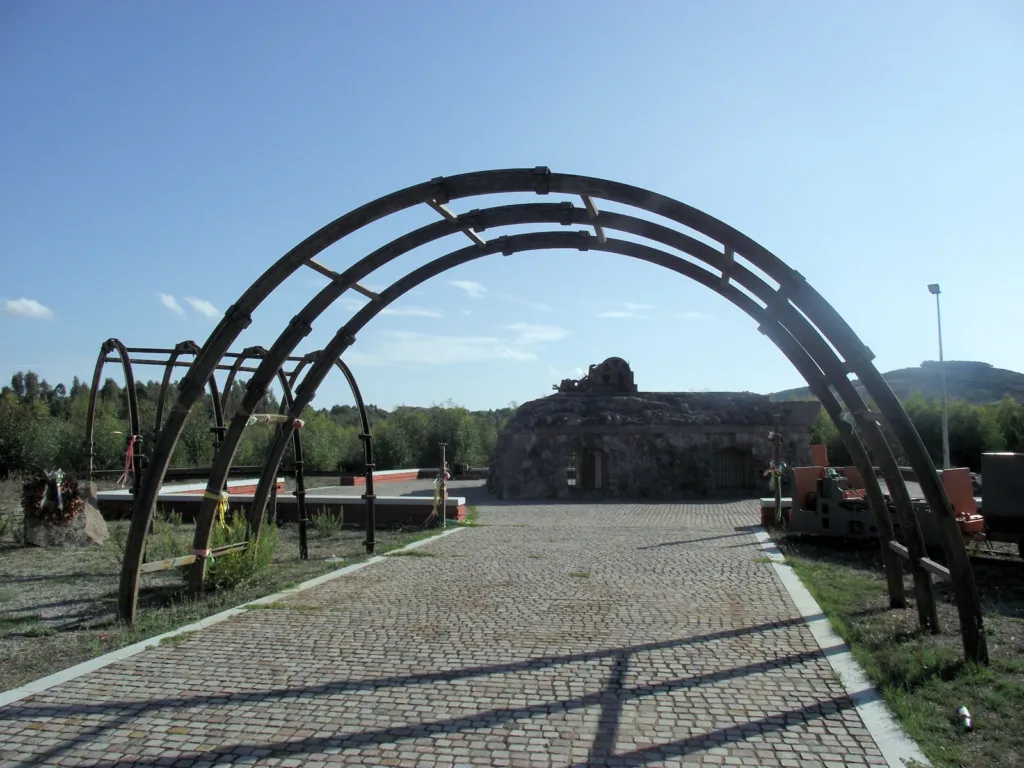
The Ministry of Culture dates Castoldi shaft to 1929 and associates its name with the mining engineer Alberto Castoldi. The installation accommodated two cages and used an electrically driven winding engine. It operated until 1941 and was subsequently used for gallery ventilation. That change of function explains why the end of extraction through a shaft did not always mean that it immediately ceased to serve a purpose.
The photograph shows a stone base beyond a sequence of curved metal elements. What survives suggests the installation’s footprint, but it does not reproduce the complete headframe. The ministry’s entry distinguishes the base from the winding-engine house and records mining equipment in the space in front. Read the ensemble as evidence of a technical system, without mistaking the outdoor area for an entrance to an underground visitor route.
Living beside the mine
The municipality’s Monumenti Aperti presentation records the expansion of the older settlement under Anselmo Roux’s management and another building phase starting in 1935. It describes workers’ homes in the eastern and western areas, managers’ residences along Viale della Libertà, and facilities for unmarried workers: dormitories, a canteen and a laundry. This arrangement reveals social differences as well as different housing needs.
The expression “workers’ village” becomes more concrete through those details. It refers to an organisation of accommodation and services around production, beyond the simple proximity of houses and a workplace. Dormitories answered different needs from family housing. The canteen and laundry supported people arriving to work. Looking at this network restores a human dimension to industrial structures without inventing individual life stories that the sources do not document.

Saint Barbara and the community
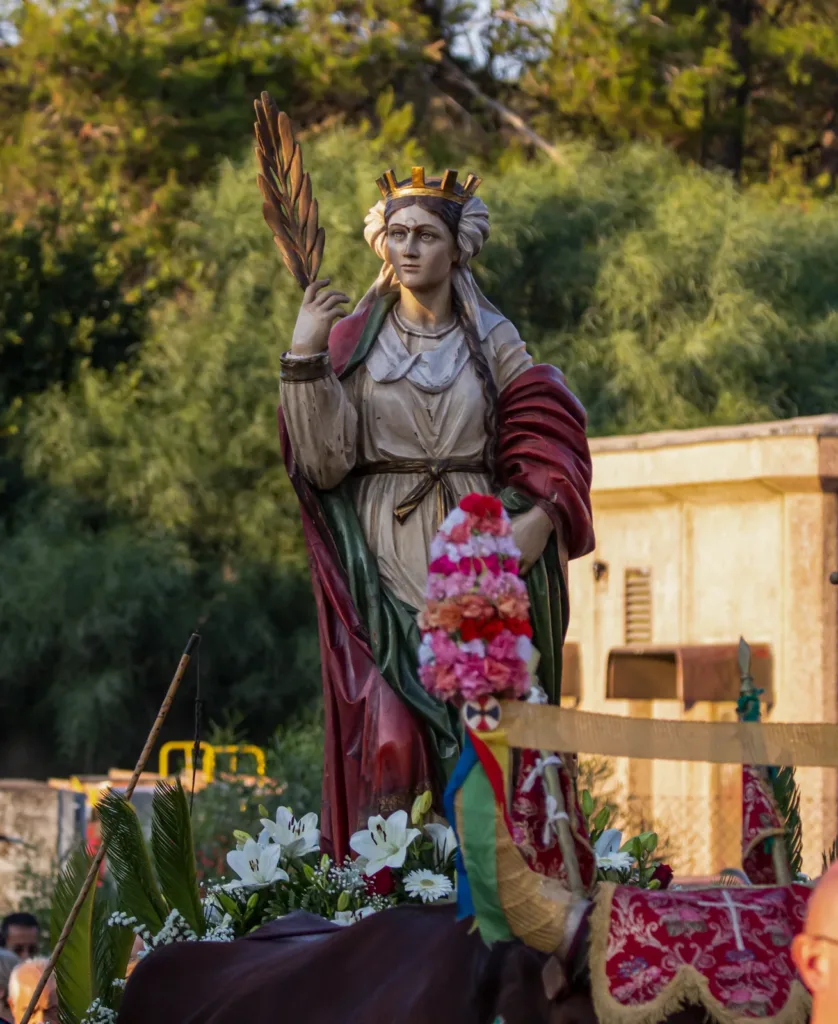
Carbonia Turismo includes Saint Barbara’s church among the central buildings of communal life in Bacu Abis and recalls the saint’s connection with miners. The photograph of her statue during a procession introduces this aspect of local history. Its subject is a religious celebration, rather than a reconstructed scene of mine work. Both experiences belong to the same community, but each requires its own evidence and context.
In the picture, the saint rises above the flowers, with a tower beside her. The close view leaves the wider procession in the background. It records the statue and its presentation, but cannot establish the route, calendar or number of participants on its own. To attend a celebration, consult the programme for the current edition instead of treating an archive photograph as evidence of a permanent appointment.
The theatre and the village beyond coal
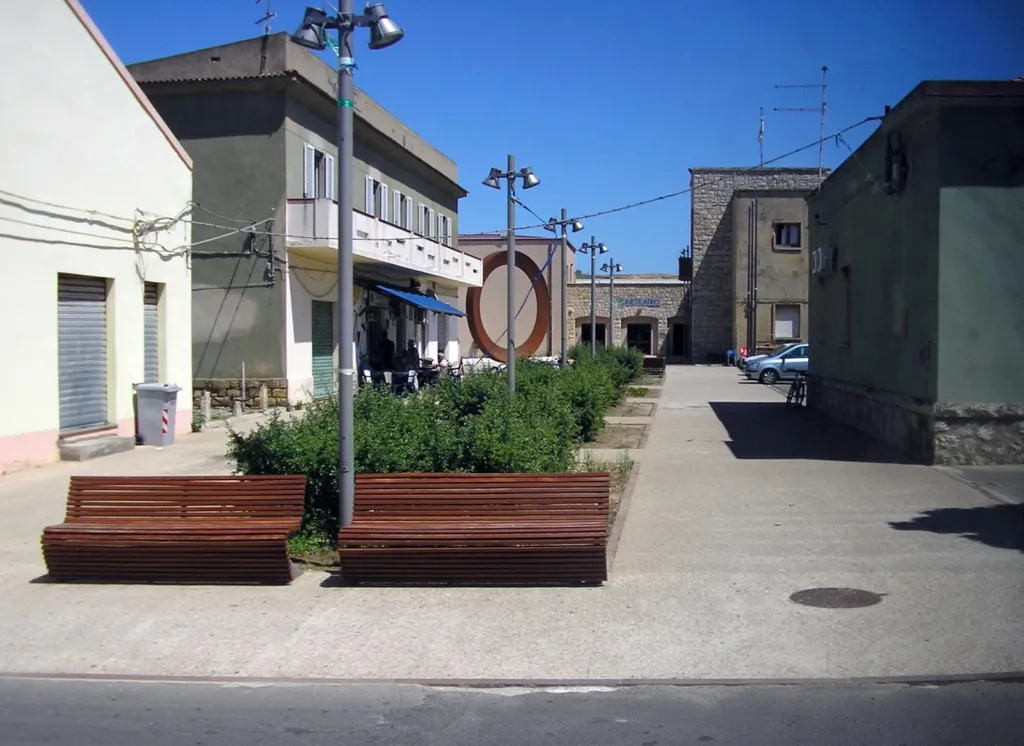
The municipal theatre page describes the Bacu Abis venue as a place for performances, companies and workshops, naming La Cernita Teatro and Teatro del Sottosuolo. It is a useful reminder that the village’s heritage also includes cultural spaces. Check forthcoming performances with the organisers: the existence of the theatre does not imply that it opens daily for tourist visits.
The photograph of the theatre square shows benches, greenery and building fronts, an environment quite different from the shaft structures. Placing the two views together makes Bacu Abis’s double character apparent: a place of industrial memory and a lived-in village. A thoughtful walk can begin with that relationship, using public points on the map and respecting residential entrances. Part of the place’s interest lies in the life that continued after its mines’ productive role ended.